BMW, Toyota Teams Up To Develop Fuel-Cell EVs

BMW and Toyota announced a groundbreaking partnership to develop hydrogen-powered vehicles together. This marks a major shift from fossil fuels with a possible first hydrogen-powered car debuting in 2028, featuring a jointly-developed powertrain.
This venture will focus on hydrogen-powered or fuel-cell electric vehicles (FCEVs) which will generate electricity through a chemical reaction between hydrogen and oxygen within a fuel cell unlike conventional EVs that rely on electricity stored in batteries.
“It is essentially electric driving,” explained Michael Rath, BMW's Vice President of Hydrogen Vehicles.

Meanwhile, Koji Sato, President and Representative Director of Toyota Motor Corporation, added, “We are pleased that the collaboration between BMW and Toyota has entered a new stage as both companies share the same passion for cars and belief in ‘technology openness’ and a ‘multi-pathway’ approach to carbon neutrality.”
FCEVs offer a practical alternative for drivers who may lack access to charging stations or require faster refuelling options. Much like traditional internal combustion-engine vehicles, hydrogen cars can be refuelled quickly at specialised stations, making them ideal for everyone.

BMW views hydrogen vehicles as a complement to battery-powered EVs rather than direct competitors, recognizing that a variety of clean energy solutions is needed to meet the diverse needs of consumers. This is inline with Toyota’s “multi-pathway” goal since day one.
However, both manufacturers also agree that infrastructure remains a significant challenge. Hydrogen refuelling stations are far less common than electric charging points, and safety concerns, particularly revolving around the flammability of hydrogen, will be thoroughly addressed through extensive crash testing.
In a related development, Toyota is reported to have scaled back its global EV output forecast for 2026 by 30%, lowering its target from 1.5 million vehicles to 1 million. This decision comes in response to a global slowdown in EV demand. In 2023, Toyota sold approximately 100,000 EVs. As of July 2024 though, sales had only reached 80,000 units.

The global slowdown in EV adoption also prompted rivals Volvo into revising its previous commitment to an all-electric lineup by 2030. During its recent “90/90 Day” event, Jim Rowan, President and CEO of Volvo Cars announced that 10% of its future models would now include hybrid vehicles, acknowledging that the market may not be fully prepared to transition exclusively to EVs.
These strategic shifts from BMW, Toyota, and Volvo highlight the evolving landscape of clean transportation. Rather than a singular solution dominating the market, a blend of battery-electric, fuel-cell, and hybrid vehicles is likely to define the future of the automotive industry as it transitions away from fossil fuels.
Gallery
Written By
Kumeran Sagathevan
More then half his life spend being obsessed with all thing go-fast, performance and automotive only to find out he's actually Captain Slow behind the wheels...oh well!
JPJ Running Numbers
KUALA LUMPUR
VRT4090
SELANGOR
BSU3327
JOHOR
JF4792J
PULAU PINANG
PSG2933
PERAK
APM1304
PAHANG
CFH9748
KEDAH
KGJ4110
NEGERI SEMBILAN
NEM2359
KOTA KINABALU
SJU4874
KUCHING
QAB7358P
Last updated 09 Oct, 2026
Fuel Price
Petrol
RON 95
RM 3.97
+1.38
RON 97
RM 4.90
+1.75
RON 100
RM 7.20
+2.20
VPR
RM 8.23
+2.00
Diesel
EURO 5 B10
RM 5.12
+2.08
EURO 5 B7
RM 5.32
+2.08
Last updated 30 Apr, 2026
Latest News
EV Charging Incentives: Malaysia vs Other Countries
Malaysia offers EV charging tax incentives, but how does it compare globally? Explore EV charger subsidies, grants and tax breaks in six other markets.
08-10-2026
Proton Sold 40,000 e.MAS Cars. But That's Not Even The Most Interesting Number
Proton e.MAS has delivered 40,000 vehicles, but the e.MAS 5's place among Malaysia's best-selling cars tells an even bigger EV story.
30-09-2026
Kuching Gets Zeekr's First East Malaysia Store, With More Coming Next Year
Zeekr opens its first East Malaysia retail location at The Spring Kuching, with permanent sales and service centres targeted for Q1 2027.
29-09-2026
Buying A Hybrid Or EV? MAA Proposes Up To RM10,000 Tax Rebate
MAA proposes a RM7,000-RM10,000 income tax rebate for hybrid and EV buyers under Budget 2027, plus incentives for home charging and old-car scrapping.
28-09-2026
Driving Up North In An EV? There's A New 240 kW Charger At Rawang R&R
TNB Electron's new 240 kW DC EV charger at R&R Rawang Northbound is now live, with free charging available until 29 Sept 2026.
28-09-2026
Could An EV Really Work As A Malaysian Police Car? PDRM Is Finding Out
PDRM is testing the Proton e.MAS 5, e.MAS 7 EV and e.MAS 7 PHEV to see whether electrified vehicles could work for Malaysian police duties.
18-09-2026
Malaysia's Electricity Protection Is Now 800 kWh - How Much Power Does An EV Use Per 100 KM?
Malaysia's electricity protection threshold is now 800 kWh. Here's how much electricity popular EVs use per 100 km and what the extra 200 kWh means.
18-09-2026
17 New Mercedes Models Are Coming To Malaysia In 2027 - Here's What We Know
Mercedes-Benz Malaysia plans 17 new models for 2027, with most set for local assembly in Pekan. Here's what we know about its ICE and EV plans.
17-09-2026
Show More
trending_flat
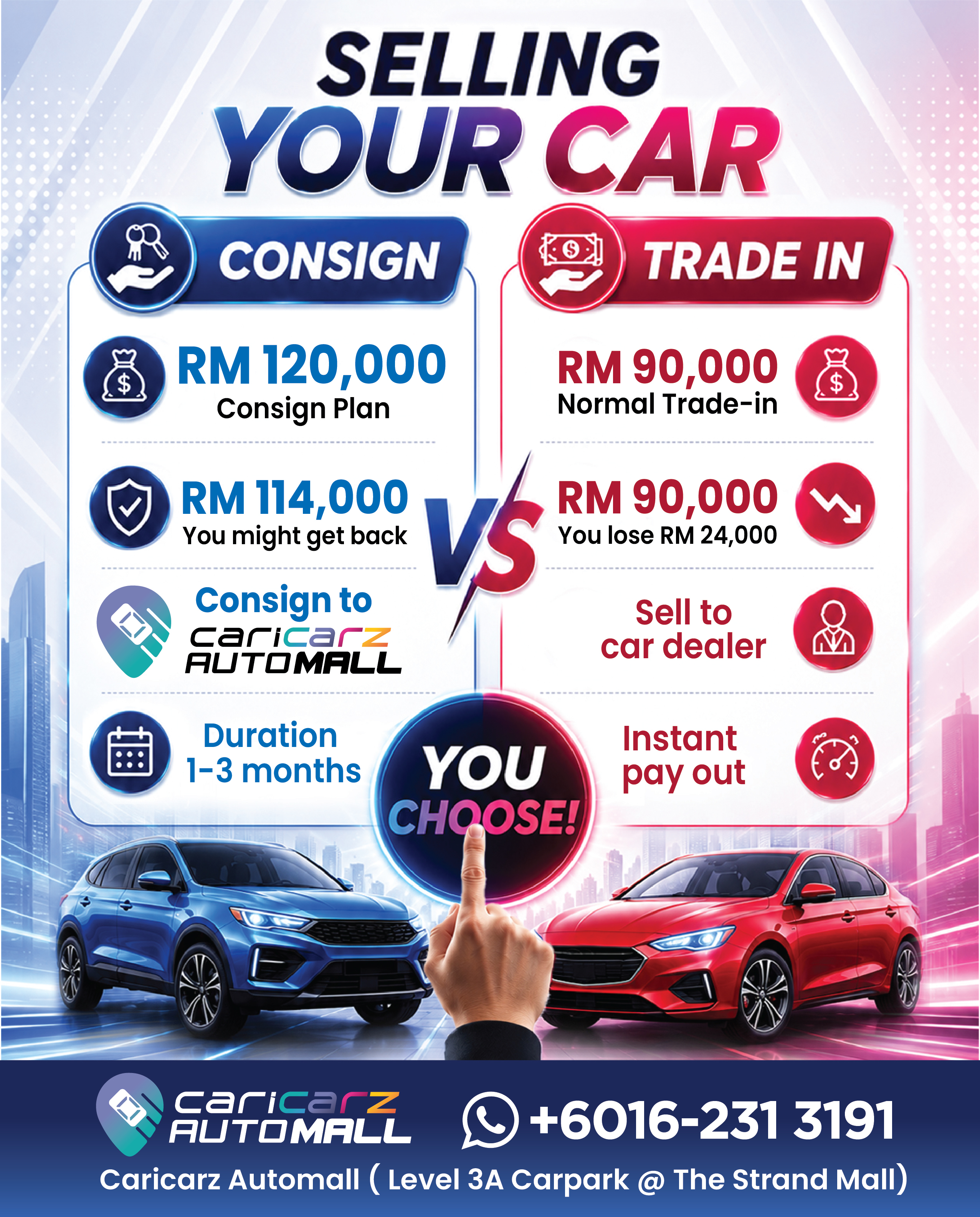
Malaysia First Used Car and EV Consignment Platform
This is the best place to sell your car at true market value. Instead of accepting low dealer trade-ins, we handle everything and connect your car directly to genuine buyers for the highest price.

Understanding CariCarzAutomall Consignment Plan

Approved 200-Check Points Inspection

7 Day Money Back Guarantee

One Year Extended Warranty

No Hidden Charge