Malaysia has introduced various incentives to encourage electric vehicle (EV) adoption. But building the charging network to support it presents another challenge.
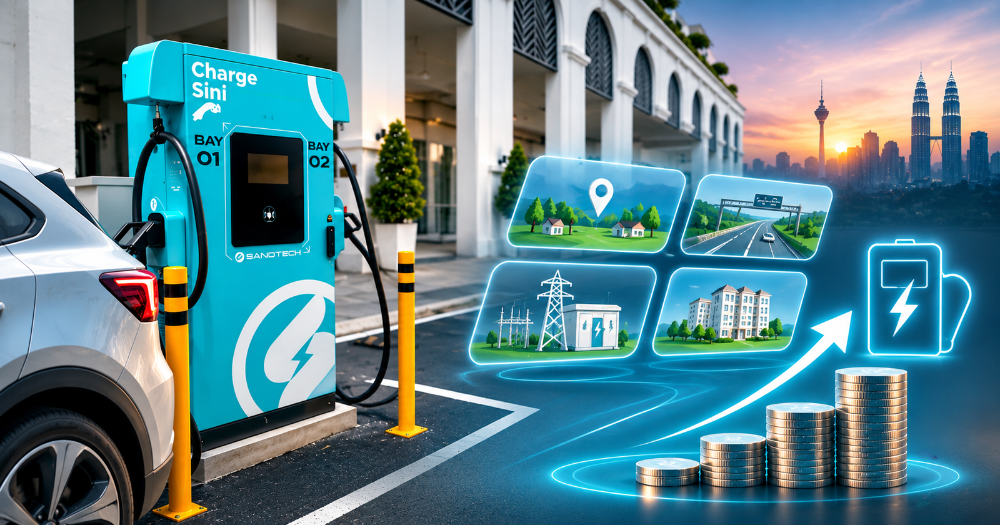
With another 22,659 public charging points needed to reach its 2030 target, the government is exploring several options to accelerate the rollout, including a proposed EV levy.
Interestingly, the idea isn't entirely new. And behind it lies a bigger question: How can Malaysia expand its charging network while keeping EV ownership affordable?
⚡ TL;DR
01
A dedicated charging fund. MITI is studying an EV levy as a possible way to finance public charging infrastructure.
02
More than just money. Electricity infrastructure, suitable locations and commercial viability remain important considerations.
03
No implementation decision yet. The levy rate, collection mechanism and potential impact on EV affordability remain uncertain.
Why Is Malaysia Considering An EV Levy?
Speaking in Parliament on Nov 16, Deputy Investment, Trade and Industry Minister Sim Tze Tzin confirmed that the proposed EV levy remains among the measures being studied to accelerate Malaysia's charging infrastructure rollout.
According to the parliamentary response reported by Bernama via Malay Mail, Malaysia had installed 7,341 public charging points as of Sept 30, representing approximately 24.5% of its 30,000-point target for 2030.
However, Sim highlighted the need to address other challenges, particularly electricity substation capacity, before deciding on the appropriate measures.
On Aug 4, Investment, Trade and Industry Minister Datuk Seri Johari Abdul Ghani suggested that proceeds from a levy on EV sales could be channelled into a dedicated fund for public charging infrastructure.
His reasoning was that Malaysia could not rely solely on vehicle manufacturers and distributors to finance a nationwide charging network.
POLICY TIMELINE
How The EV Levy Discussion Has Evolved
4 AUGUST 2026
The Initial Proposal
Johari suggests a levy on EV sales to establish a dedicated public charging infrastructure fund.
5 AUGUST 2026
The Clarification
MITI clarifies that the government has not decided to impose the levy and is evaluating the mechanism.
16 NOVEMBER 2026
Still Under Consideration
Deputy MITI Minister Sim confirms that the proposed levy remains among the options being studied.
More than three months later, the levy remains a possibility rather than an approved policy.
The RM3.3 Billion Backstory
To understand the proposal, it is worth revisiting Malaysia's earlier EV incentives.
For four years, the government provided import duty, excise duty and sales tax exemptions for completely built-up (CBU) EVs to stimulate market growth and attract investment.
MALAYSIA'S EARLIER EV INCENTIVES
RM3.3 BILLION
Tax revenue forgone through tax exemptions for imported EVs over four years, according to MITI's August 2026 statement.
Important distinction: This represents forgone tax revenue, not government expenditure on EV charging infrastructure.
Source: Bernama, 4 August 2026.
However, Johari said investment in public charging infrastructure had fallen short of expectations.
While the tax exemptions for imported EVs were not extended beyond 2025, incentives for locally assembled EVs remain available under the existing policy until the end of 2027.
The proposed levy could introduce another approach to supporting Malaysia's EV ecosystem through a dedicated infrastructure funding mechanism.
Why Building More EV Chargers Isn't Just About Money
There is considerably more to establishing a public charging station than purchasing the charging equipment.
Depending on the location and capacity required, projects may involve electricity supply upgrades, cabling, civil works, regulatory approvals and ongoing maintenance.
Electricity infrastructure is particularly important for high-powered DC fast chargers.
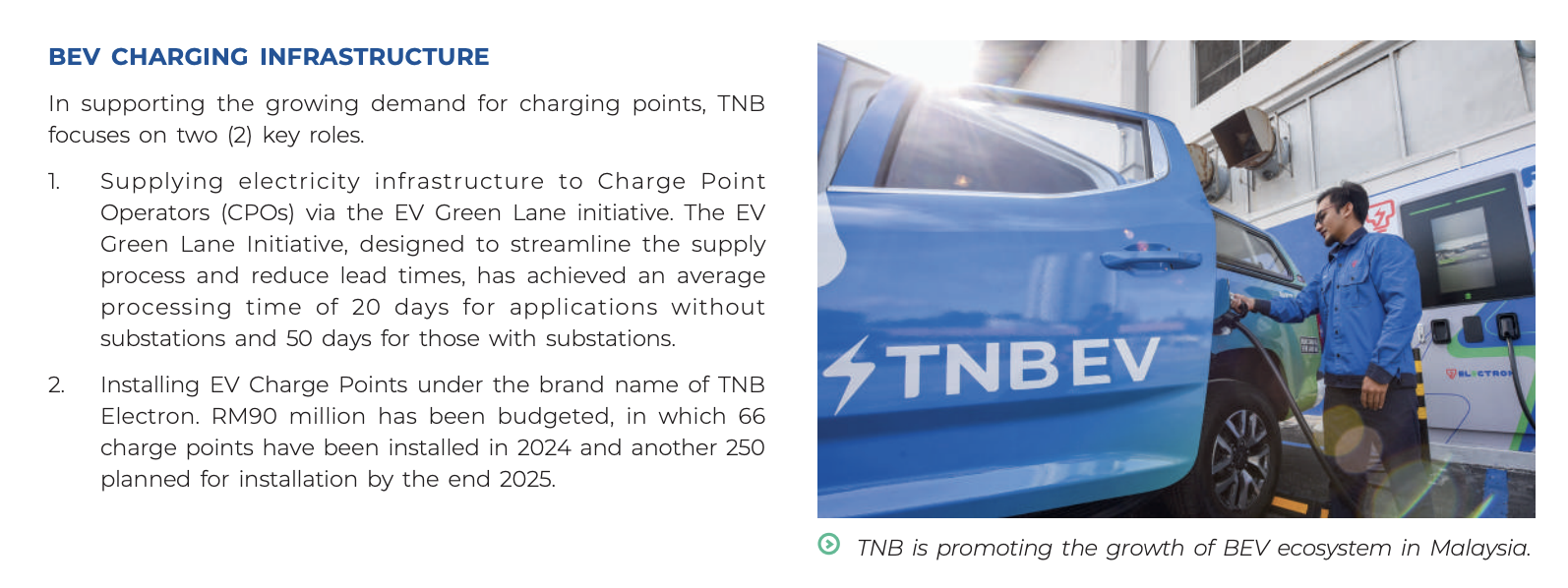
Tenaga Nasional Bhd's (TNB) 2024 Sustainability Report provides an interesting illustration of this challenge.
THE ELECTRICITY INFRASTRUCTURE CHALLENGE
Why Electricity Supply Matters
Average electricity supply application processing times under TNB's EV Green Lane initiative in 2024.
Without a substation
20 days
With a substation
50 days
Applications involving substations recorded longer average processing times, illustrating the additional considerations associated with electricity infrastructure.
Source: TNB Sustainability Report 2024. Historical average application processing times, not total charging station construction times or current service guarantees.
TNB's EV Green Lane initiative recorded average application processing times of 20 days for projects without substations and 50 days for those requiring substations. (Source: TNB Sustainability Report 2024)
Additional funding could support infrastructure development, but projects would still require electricity supply planning and implementation.
How Does Malaysia Currently Encourage EV Charger Investment?
Malaysia's public charging network is largely driven by private-sector investment, with 20 charge point operators (CPOs) actively involved in infrastructure development, according to Sim.
To encourage such investments, the government currently offers qualifying charging operators tax incentives under the Green Investment Tax Allowance (GITA) scheme.
Essentially, this allows eligible companies to reduce their taxable income based on qualifying investments in charging infrastructure.
Interestingly, Budget 2027 proposes extending the scheme's application period until the end of 2030, but with less generous incentive rates.
BUDGET 2027 EXPLAINED
How Tax Incentives For EV Charging Projects Could Change
A comparison of the existing and proposed Green Investment Tax Allowance (GITA) Project incentive for qualifying EV charging station projects.
Tax Incentive
Existing
Proposed
Investment tax allowance
100%
60%
Statutory income set-off limit
100%
70%
What Do These Terms Mean?
01 | Investment Tax Allowance
The percentage of qualifying investment expenditure used to calculate the tax allowance available to the company.
02 | Statutory Income Set-Off Limit
The maximum proportion of a company's statutory income that can be offset using the available tax allowance in a year of assessment.
PROPOSED APPLICATION PERIOD
1 Jan 2027 – 31 Dec 2030
A five-year incentive period for qualifying projects, subject to applicable eligibility requirements and conditions.
Important distinction: These percentages refer to tax allowances and income set-off limits, not direct cash subsidies or reimbursements for charger installation costs.
Source: Ministry of Finance, Budget 2027 Tax Measures, Appendix 25; PwC Malaysia and Deloitte.
In simpler terms, under the proposed scheme, qualifying charging projects would generate a smaller tax allowance for the same eligible investment expenditure, while the proportion of statutory income that can be offset would also be reduced.
While tax incentives help reduce the financial burden of investing in charging infrastructure, a dedicated charging fund could offer another avenue to support its development.
Context matters: The proposed EV levy and Budget 2027 tax incentive revisions are separate policy developments. No official link between the two measures has been established.
Who Could Ultimately Pay For The EV Levy?
For prospective EV buyers, this is perhaps the most important question. Although Johari initially suggested a levy on EV sales, the government has not announced how it would be collected or who would be responsible for paying it.
During his Aug 5 clarification, the minister acknowledged that costs imposed on manufacturers could ultimately be passed on to consumers.
However, this does not necessarily mean EV prices will increase. Much would depend on the final mechanism, levy rate and how affected businesses respond.
EV LEVY POLICY STATUS
What Remains Unconfirmed?
?Levy amount or rate
?Parties responsible for payment
?Applicable vehicles and potential exemptions
?Implementation date
?Collection and allocation mechanism
For now: The proposed levy remains under study.
Until these details are available, there is no confirmed basis for estimating its effect on EV prices.
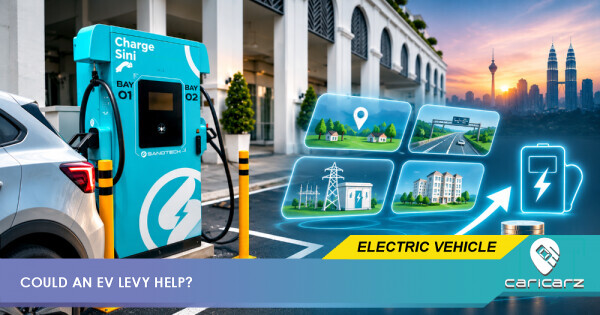
Where Could A Dedicated Charging Fund Make A Difference?
A dedicated fund could potentially support projects where commercial considerations alone make investment more challenging.
CHARGING INFRASTRUCTURE
Four Potential Funding Priorities
📍
Smaller Towns & Rural Areas
Locations where lower charging demand may make upfront investment harder to justify.
🛣️
Highway Charging
Additional charging capacity at strategic locations supporting long-distance travel.
⚡
Electricity Infrastructure
Grid connections and electrical upgrades required to support new charging stations.
🏢
Residential Areas
Public or shared charging facilities for residents with limited access to home charging.
Illustrative funding possibilities based on infrastructure needs. These are not confirmed government allocation plans.
Ultimately, the effectiveness of such a fund would depend on how projects are selected, how the money is allocated and whether the resulting facilities address motorists' charging needs.
Can Malaysia Balance EV Affordability With Infrastructure Investment?
Interestingly, the levy discussion comes as the government is also exploring ways to make EV ownership more accessible.
Earlier this month, Anthony Loke revealed that the government was exploring targeted measures to improve EV affordability, taking into account both vehicle purchase prices and longer-term ownership costs.
While these are separate policy discussions, they highlight two complementary objectives.
More affordable vehicles could encourage wider adoption, while a more extensive charging network could make EV ownership practical for more Malaysians.
If the levy materialises, its design could play an important role in balancing both objectives.
Could An EV Levy Be Part Of The Solution?
A dedicated fund could provide Malaysia with an additional avenue for financing public charging infrastructure.
However, its effectiveness would depend on more than the amount collected. Electricity supply, charging locations, commercial viability and the potential impact on vehicle affordability would also matter.
THE BIGGER PICTURE
Affordable EVs. Accessible Charging.
Affordable EVs can encourage adoption. Accessible and reliable charging infrastructure can make that adoption sustainable.
Perhaps the success of an EV levy, should it be introduced, should ultimately be measured not simply by how much money it raises, but by the improvements it delivers for motorists.
YOUR QUESTIONS ANSWERED
MALAYSIA EV LEVY FAQ
Has Malaysia introduced an EV levy?
No. As of Nov 18, 2026, the proposed EV levy remains under consideration, with no implementation decision announced.
What is the purpose of Malaysia's proposed EV levy?
MITI previously suggested that proceeds from a levy on EV sales could finance a dedicated fund for the development of public EV charging infrastructure.
Will the proposed EV levy make electric vehicles more expensive?
This remains uncertain. MITI has acknowledged the possibility of additional manufacturer costs being passed on to consumers, but no levy rate or collection mechanism has been announced.
Will existing EV owners have to pay the levy?
No such requirement has been announced. The earlier proposal referred to EV sales, with the final mechanism yet to be determined.
How many more EV charging points does Malaysia need?
Based on the Sept 30, 2026 installation count of 7,341 public charging points, another 22,659 are needed to reach Malaysia's 30,000-point target by 2030.
What EV charging incentives are proposed under Budget 2027?
Budget 2027 proposes extending the GITA application period for qualifying EV charging station projects until Dec 31, 2030, with an allowance of 60% of qualifying expenditure that can be set off against up to 70% of statutory income.
A Bachelor of English Language and Literature graduate with an obsession for the finer details. Sofea uses her background in translation to decode the technicalities of automotive innovation. She is dedicated to delivering impactful, meticulously researched articles that provide a narrative far beyond the spec sheet. LinkedIn: https://bit.ly/3C018vv
Malaysia offers EV charging tax incentives, but how does it compare globally? Explore EV charger subsidies, grants and tax breaks in six other markets.
Malaysia is studying an EV levy to fund more public chargers. Explore the proposal, infrastructure challenges, Budget 2027 incentives and EV affordability.
Malaysia First Used Car and EV Consignment Platform
This is the best place to sell your car at true market value. Instead of accepting low dealer trade-ins, we handle everything and connect your car directly to genuine buyers for the highest price.
Understanding CariCarzAutomall Consignment Plan
Approved 200-Check Points Inspection
7 Day Money Back Guarantee
One Year Extended Warranty
No Hidden Charge
About Us
CarzAutoMedia: Stay connected to the latest car news! Get instant updates on new releases, industry trends, and automotive innovations. Your go-to source for 24/7 coverage of everything automotive.