Fix Public Transport Reliability Before Limiting Car Ownership - Experts
.jpg) Improving the speed and reliability of Malaysia’s existing public transport system should be the immediate priority in tackling congestion, rather than introducing measures to curb vehicle ownership, transport experts say.
Improving the speed and reliability of Malaysia’s existing public transport system should be the immediate priority in tackling congestion, rather than introducing measures to curb vehicle ownership, transport experts say.
They were responding to suggestions that limiting car ownership could help address worsening traffic congestion. However, Transport Minister Anthony Loke dismissed the idea, describing it as a sensitive issue.
Loke said traffic congestion has become a recurring pattern, particularly ahead of festive periods due to company dinners, shopping activities, and early interstate travel. He also pointed to structural factors, including the rapid rise in vehicle ownership.
According to New Straits Times (NST), transport policy expert Wan Agyl Wan Hassan said Malaysia’s transport ecosystem has historically encouraged car ownership through long loan tenures, fuel subsidies, which have only recently been rationalised, and relatively low urban parking costs.
.jpg)
“Transport outcomes reflect economic signals. If ownership is affordable while congestion costs are largely externalised, people will naturally buy more cars,” he told NST.
Wan Agyl said the recent diesel subsidy rationalisation in 2024 and reforms to RON95 pricing indicate a gradual policy recalibration.
“The key is not restricting ownership abruptly, but aligning cost signals gradually,” he added.
With ownership restrictions unlikely, he stressed that short-term congestion management should focus on strengthening the performance of existing public transport services.
Among the immediate measures proposed are stricter enforcement of dedicated bus lanes during peak hours, increasing service frequency on high-demand routes such as MRT2 (Putrajaya Line), KTM services and major trunk corridors, as well as encouraging staggered reporting hours for government-linked companies and large office clusters in Kuala Lumpur, Petaling Jaya, and Cyberjaya.
Despite significant rail investments, Malaysia’s public transport modal share remains between 20 and 25 per cent, below the 40 per cent target.
“The issue is not a lack of infrastructure; it is behavioral economics and convenience,” Wan Agyl further noted.
He also highlighted the importance of improving first- and last-mile connectivity through better sidewalks, shaded walkways, safe crossings, and more reliable feeder bus services. Feeder buses, he said, should be given peak-hour priority where road conditions allow.
Parking reform near transit stations, particularly reducing minimum parking requirements within a 500 to 800 metre radius could also gradually influence commuter behaviour, he added.
On congestion charges, Wan Agyl noted that global cities such as Singapore and London implemented pricing mechanisms only after establishing robust public transport alternatives.
“In Malaysia, the network is still being strengthened,” he said, citing the yet-to-be-operational MRT3, delays to LRT3, and inconsistent feeder reliability.
Meanwhile, Road Safety Council of Malaysia executive council member Datuk Suret Singh called for a strategic action plan to ensure 40 per cent of trips in Greater Klang Valley are made via public transport by 2030 under the Transport Masterplan.

He said improving first- and last-mile connectivity and ensuring reliable service frequency are crucial to encouraging commuters to shift away from private vehicles. Suret also suggested introducing congestion charges during peak hours and installing digital displays at bus stops to provide real-time arrival information.
Experts maintain that without faster, more predictable, and convenient public transport, efforts to manage congestion through ownership limits or pricing measures are unlikely to succeed.
Written By
Anis
Previously in banking and e commerce before she realized nothing makes her happier than a revving engine and gleaming tyres........
JPJ Running Numbers
KUALA LUMPUR
VRS9140
SELANGOR
BSU2543
JOHOR
JF3245J
PULAU PINANG
PSG1724
PERAK
APL9464
PAHANG
CFH9373
KEDAH
KGJ3585
NEGERI SEMBILAN
NEM1958
KOTA KINABALU
SJU4372
KUCHING
QAB7145P
Last updated 03 Oct, 2026
Fuel Price
Petrol
RON 95
RM 3.97
+1.38
RON 97
RM 4.90
+1.75
RON 100
RM 7.20
+2.20
VPR
RM 8.23
+2.00
Diesel
EURO 5 B10
RM 5.12
+2.08
EURO 5 B7
RM 5.32
+2.08
Last updated 30 Apr, 2026
Related News
Vehicles Over 15 Years Require Mandatory Checks - MP
Vehicles older than 15 years should undergo mandatory inspections for road tax renewal, says MP.
14-02-2025
Traffic Reported At A Crawl On Several Major Routes
Slow-moving traffic was reported on several major highways in the Peninsula as of 12.30 p.m. on Monday, September 16.
16-09-2024
Government Announced Major Improvements On Mahameru-Jalan Tun Razak
The government is about to implement a comprehensive improvement plan to alleviate traffic congestion along the 1.4-kilometer stretch from Mahameru to Jalan Tun Razak, which will cost RM75 million.
01-08-2024
KL-Karak Highway Widening Project Starts This Year
The federal government has approved a project to widen the Kuala Lumpur-Karak Expressway as a means of reducing traffic congestion.
02-02-2024
Exercise Caution On The Road And Service Your Vehicles Before Heading Out Of Town - Road Safety Advocates
Two road safety advocacy groups are urging people to drive safely and keep their property and belongings safe from theft.
19-01-2023
Effective Immediately - FT Ministry Prohibits Heavy Vehicles From Entering KL City Centre During Peak Hours
The Federal Territories Ministry, through the Kuala Lumpur City Hall (DBKL), has immediately prohibited heavy vehicles weighing more than 7.5 tonnes from entering the city centre.
22-06-2022
Latest News
Paid Your Road Tax Through MyEG? The Company Owes JPJ More Than RM200 Million
Zetrix AI, formerly MyEG Services, owes the government over RM200 million in JPJ collections. Here's what road tax and licence users need to know.
02-10-2026
Want F1 At Sepang Without The Traffic? RTM Is Showing It All Live
RTM is showing the full F1 weekend at Sepang live, including practice, qualifying and Sunday's race. Here's the TV Okey and RTMKlik schedule.
02-10-2026
Volvo Is Selling 80 Low-Mileage Cars From Its Own Fleet, Starting At RM148K
Volvo Malaysia is selling 80 low-mileage corporate fleet cars from RM148,000, with some showing just 2,000 KM. The sale runs Oct 10-11 in PJ.
02-10-2026
Proton Has 3 Big Requests For Budget 2027. Here's Why Drivers Should Care
Proton wants Budget 2027 to support xEVs, deepen automotive localisation and expand voluntary old-car renewal. Here's why Malaysian drivers should care.
02-10-2026
F1 Disappeared From Sepang For 9 Years. It Came Back And Immediately Broke A Record
F1 returns to Sepang after nine years, with nearly 100,000 tickets sold and the circuit recording its highest-ever race ticket sales.
01-10-2026
Malaysia Isn't Getting Barrier-Free Tolls Yet. But The Technology Is Already Here
Malaysia isn't rushing MLFF, but Enhanced RFID and ANPR toll technology are already here. Here's what the changes mean for Malaysian motorists.
01-10-2026
Volvo Just Opened A New Centre In Kuching. So Why Can't You Buy A Car There?
Volvo has opened a new 2S centre in Kuching offering service and spare parts, but new-car sales will only come once it becomes a full dealership.
30-09-2026
Why Extending The ECRL To Rantau Panjang Could Be A Much Bigger Deal Than It Sounds
The proposed ECRL extension to Rantau Panjang could link Malaysia with Thailand and a wider Asian rail and port network. Here's why it matters.
29-09-2026
Show More
trending_flat
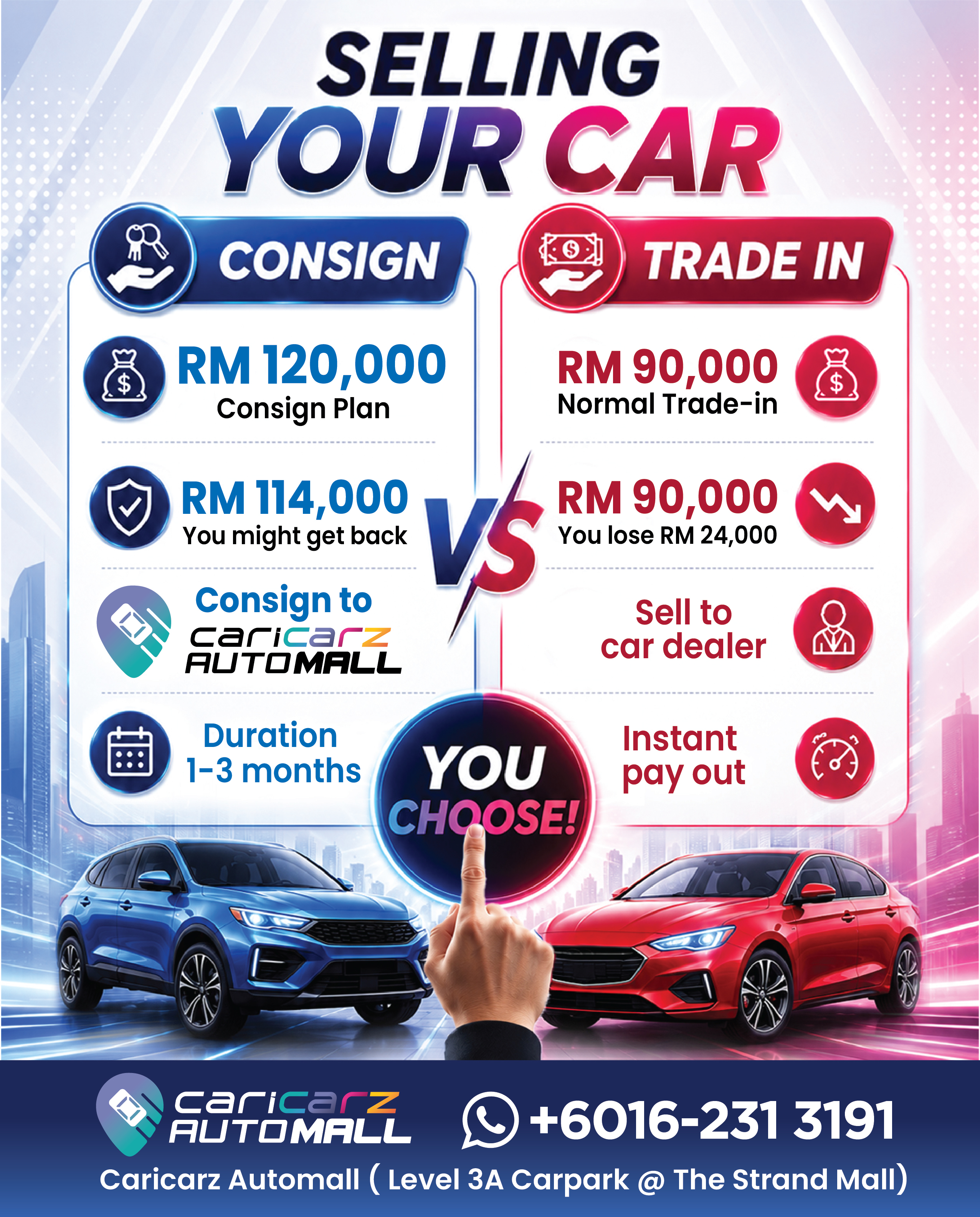
Malaysia First Used Car and EV Consignment Platform
This is the best place to sell your car at true market value. Instead of accepting low dealer trade-ins, we handle everything and connect your car directly to genuine buyers for the highest price.

Understanding CariCarzAutomall Consignment Plan

Approved 200-Check Points Inspection

7 Day Money Back Guarantee

One Year Extended Warranty
No Hidden Charge