Is Malaysia Being Too Strict? How We Compare To Thailand’s 'EV Hub' Strategy

Perak’s investment chief, Loh Sze Yee, dropped a bombshell: BYD’s plan to build a massive EV factory in Tanjung Malim is now in "significant uncertainty."
The reason? A clash over conditions from the Federal Government that has the industry asking: Are we protecting our local market so hard that we’re actually scaring the big players away?
As our neighbors in Thailand continue to roll out the red carpet for EV giants, it's time to do a deep dive into the "80:20 rule" and whether Malaysia's strategy is a masterclass in development or a missed opportunity.
The "Tanjung Malim" Drama: What's Really Happening?

BYD, currently the top-selling EV brand in Malaysia, was all set to transform Perak into an electric vehicles (EV) powerhouse. However, recent friction with the Ministry of Investment, Trade, and Industry (MITI) has thrown a wrench in the works.
The two "Speed Bumps":
- The 80:20 Export-to-Domestic Ratio: Locally assembled BYD vehicles must adhere to a requirement where 80% of production is exported, leaving only 20% for the local market (capped at roughly 10,000 units/year).
- 40% Localisation Requirement: To safeguard local vendors, MITI requires that 40% of the vehicle's components be sourced within Malaysia right from the start.
Perak officials are calling this a "sudden shift" that disrupts trust. However, MITI Minister Datuk Seri Johari Abdul Ghani maintains these rules are non-discriminatory and applied to all high-volume automotive projects to ensure foreign investments actually contribute to our global supply chain.
Malaysia vs. Thailand: The Tale of Two EV Hubs

To understand if Malaysia is being "too strict," we have to look across the border, Thailand, and their 2026 strategy is a stark contrast to ours.
The "80:20" Elephant in the Room: Protection or Progress?
While MITI frames the 80:20 rule as a "Pro-Export" strategy to turn Malaysia into a global hub, critics and state officials see a different reality: a high-stakes game of industrial protection.
The logic is simple: By capping domestic sales at 20%, the government is effectively building a "firewall" around national carmakers. It ensures that while foreign giants can build here, they cannot easily "cannibalize" the market share of Proton and Perodua, both of whom support a massive local vendor chain with local content levels reaching up to 90%.
MITI’s "Take It or Leave It" Ultimatum:
- The "Tax-Free" Fast Track: Export 80% of your fleet and enjoy full tax exemptions.
- The "Domestic Tax" Penalty: Sell more than 20% locally, but lose your competitive edge by paying standard industrial duties, essentially a "success tax" for winning over Malaysian buyers.
The Reality Check: BYD isn't just looking at Malaysia in a vacuum; they already have massive production hubs in Thailand and Indonesia. If a Malaysian factory is forced to be an "export-only" shop, BYD would effectively be competing against itself in the region.
Why would a global giant navigate Malaysia’s rigid 40% localization and 80% export rules when our neighbors are offering "Local First" strategies and a more flexible staircase to production? By trying to protect our national brands, we risk becoming a "Plan B" destination, or worse, being skipped entirely in the race for the 2026 EV crown.
A Crisis of Confidence: Is "Protection" Costing Us Our Reputation?
This "Plan B" risk isn't just theoretical. The friction between Perak’s state aspirations and MITI’s federal requirements has sparked a deeper debate: Is Malaysia becoming too difficult to play with?
Loh didn't mince words when he warned that these "last-minute policy shifts" are undermining investor trust. While MITI maintains that these rules have existed since the National Automotive Policy (NAP 2020), the sudden enforcement on a high-profile player like BYD has created a massive "he-said, she-said" regarding policy consistency.
This leaves Malaysia caught in a high-stakes tug-of-war between two very different visions for the future:
1. The "Safety First" Approach (Pro-Development)
This side argues that we cannot open the gates without a toll. If we don’t demand a 40% Local Content Requirement (LCR), foreign giants could simply import cheap pre-made kits from China, assemble them in a few hours, and call them "Made in Malaysia."
- The Goal: Ensure our local SMEs (who make tires, seats, and glass) actually get a piece of the pie.
- The Fear: Without these rules, our local vendors end up with nothing but "empty warehouses" while foreign supply chains take over.
2. The "Big Picture" Approach (Pro-Investment)
This side argues that in the 2026 EV race, being picky is a luxury we can’t afford. They believe that forcing a 40% local parts rule on a brand-new technology (EV batteries and motors) is setting the bar too high, too fast.
- The Goal: Get the factory built, create the jobs, and let the supply chain mature naturally over time.
- The Logic: "40% of something is better than 40% of nothing." If the conditions are so tough that BYD walks away, our local vendors get 0% of the work anyway.
The Big Question: Are we being too protective?
Should Malaysia loosen the 80:20 rule to secure the BYD deal, or should we stand our ground to protect Proton, Perodua, and our local vendors?
Drop your thoughts in the comments! Does Perak deserve this win, or is MITI right to be strict?
Read: Farewell to Budget High-Tech EV? MITI’s Terms Could Force BYD Out of Tanjung Malim
Read: MITI Breaks Silence: The Truth Behind the '80% Export' Ultimatum
Written By
Sofea Najmi
A Bachelor of English Language and Literature graduate with an obsession for the finer details. Sofea uses her background in translation to decode the technicalities of automotive innovation. She is dedicated to delivering impactful, meticulously researched articles that provide a narrative far beyond the spec sheet. LinkedIn: https://bit.ly/3C018vv
JPJ Running Numbers
KUALA LUMPUR
VRU5624
SELANGOR
BSU4946
JOHOR
JG483J
PULAU PINANG
PSG5623
PERAK
APM3675
PAHANG
CFJ1646
KEDAH
KGJ5163
NEGERI SEMBILAN
NEM3342
KOTA KINABALU
SJU6145
KUCHING
QAB7816P
Last updated 20 Oct, 2026
Fuel Price
Petrol
RON 95
RM 3.97
+1.38
RON 97
RM 4.90
+1.75
RON 100
RM 7.20
+2.20
VPR
RM 8.23
+2.00
Diesel
EURO 5 B10
RM 5.12
+2.08
EURO 5 B7
RM 5.32
+2.08
Last updated 30 Apr, 2026
Related News
Market Report: Malaysia's Auto Sector Is Defying All Expectations
Malaysia’s auto sector is defying expectations in 2026! Discover why vehicle registrations are nearing record highs based on JPJ data, how EV sales surged 85%, and what the new policy changes mean for you.
14-07-2026
The RM200k EV Floor Isn't 'Protectionism' — It’s A Power Move To Force Global Brands To Build In Malaysia
Is Malaysia's RM200k EV price floor protectionism? Discover MITI's strategic plan to force global brands into local assembly and boost the semiconductor ecosystem.
12-05-2026
Latest News
Proton e.MAS Puts Its Top Technicians To The Test With Real-World EV Challenges
Proton e.MAS puts its top technicians through real-world EV challenges, testing diagnostics, high-voltage troubleshooting and aftersales skills.
16-10-2026
Shopping At Atria? ChargeSini's New 120kW EV Charger Is Now Live!
ChargeSini's new 120kW DC fast charger at Atria Shopping Gallery, PJ, is now live with two charging bays. Here's what EV drivers should know.
16-10-2026
EV Charging Incentives: Malaysia vs Other Countries
Malaysia offers EV charging tax incentives, but how does it compare globally? Explore EV charger subsidies, grants and tax breaks in six other markets.
08-10-2026
Proton Sold 40,000 e.MAS Cars. But That's Not Even The Most Interesting Number
Proton e.MAS has delivered 40,000 vehicles, but the e.MAS 5's place among Malaysia's best-selling cars tells an even bigger EV story.
30-09-2026
Kuching Gets Zeekr's First East Malaysia Store, With More Coming Next Year
Zeekr opens its first East Malaysia retail location at The Spring Kuching, with permanent sales and service centres targeted for Q1 2027.
29-09-2026
Buying A Hybrid Or EV? MAA Proposes Up To RM10,000 Tax Rebate
MAA proposes a RM7,000-RM10,000 income tax rebate for hybrid and EV buyers under Budget 2027, plus incentives for home charging and old-car scrapping.
28-09-2026
Driving Up North In An EV? There's A New 240 kW Charger At Rawang R&R
TNB Electron's new 240 kW DC EV charger at R&R Rawang Northbound is now live, with free charging available until 29 Sept 2026.
28-09-2026
Could An EV Really Work As A Malaysian Police Car? PDRM Is Finding Out
PDRM is testing the Proton e.MAS 5, e.MAS 7 EV and e.MAS 7 PHEV to see whether electrified vehicles could work for Malaysian police duties.
18-09-2026
Show More
trending_flat
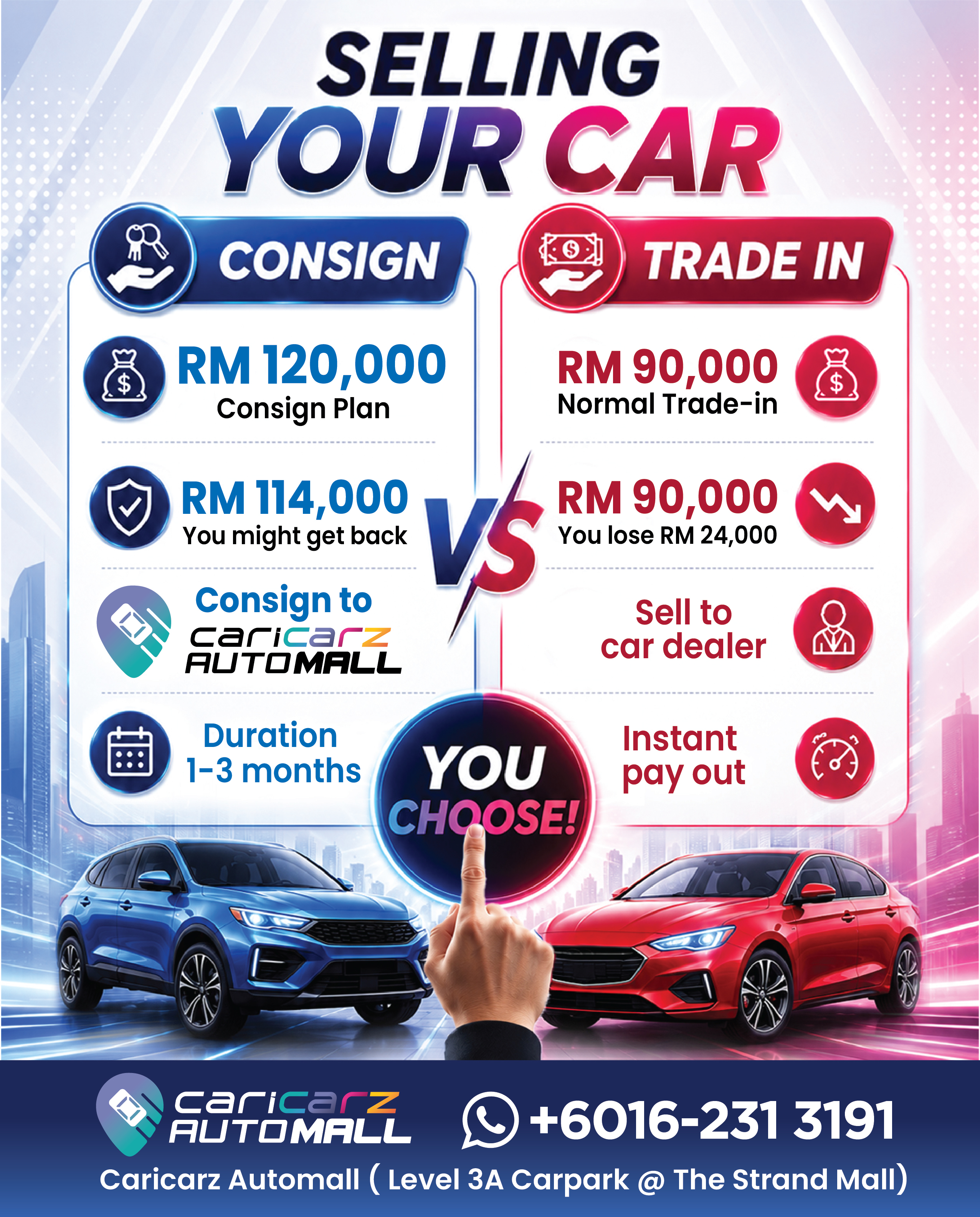
Malaysia First Used Car and EV Consignment Platform
This is the best place to sell your car at true market value. Instead of accepting low dealer trade-ins, we handle everything and connect your car directly to genuine buyers for the highest price.

Understanding CariCarzAutomall Consignment Plan

Approved 200-Check Points Inspection

7 Day Money Back Guarantee

One Year Extended Warranty

No Hidden Charge