ECRL Vs Driving To Kota Bharu: Petrol, EV Or Train, Which Costs Less?
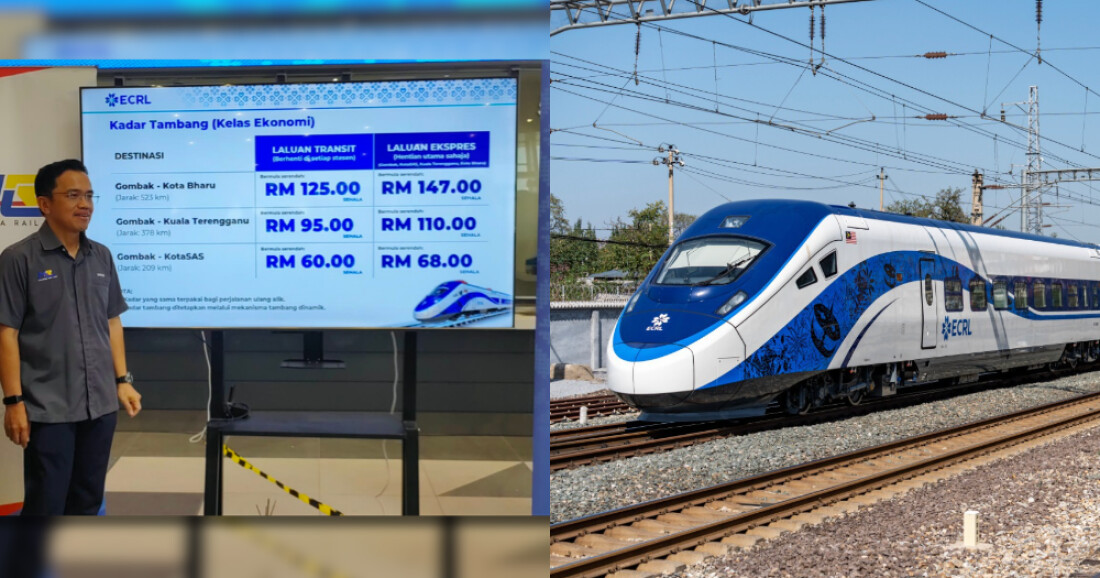
RM125 for an ECRL ticket to Kota Bharu sounds reasonable enough. But bring three adult friends along, and that's RM500 for a one-way trip.
For the same journey, four people could share the petrol bill in one car. And if that car happens to be electric, the calculation gets even more interesting.
So, is taking the train actually cheaper than driving?
With the East Coast Rail Link (ECRL) passenger fares now announced, we've compared the numbers for petrol cars, EVs and train passengers.
As it turns out, the cheapest option depends on more than just the price of a ticket. Who you're travelling with, whether you're eligible for discounted fares and even where you charge your EV could change the answer.
THE QUICK TAKE
ECRL: Economy Transit tickets from Gombak to Kota Bharu start at RM125 per adult, one-way.
Petrol: Our illustrative 420 km drive costs approximately RM58.51 with BUDI95 or RM135.83 with unsubsidised RON95.
EV: The same journey could consume around 75.6 kWh, but electricity costs depend on charging rates.
Discounts: Eligible ECRL passengers can receive concessions of 40% or 50%, subject to terms and conditions.
RM125 By Train. How Much Would Driving Cost?
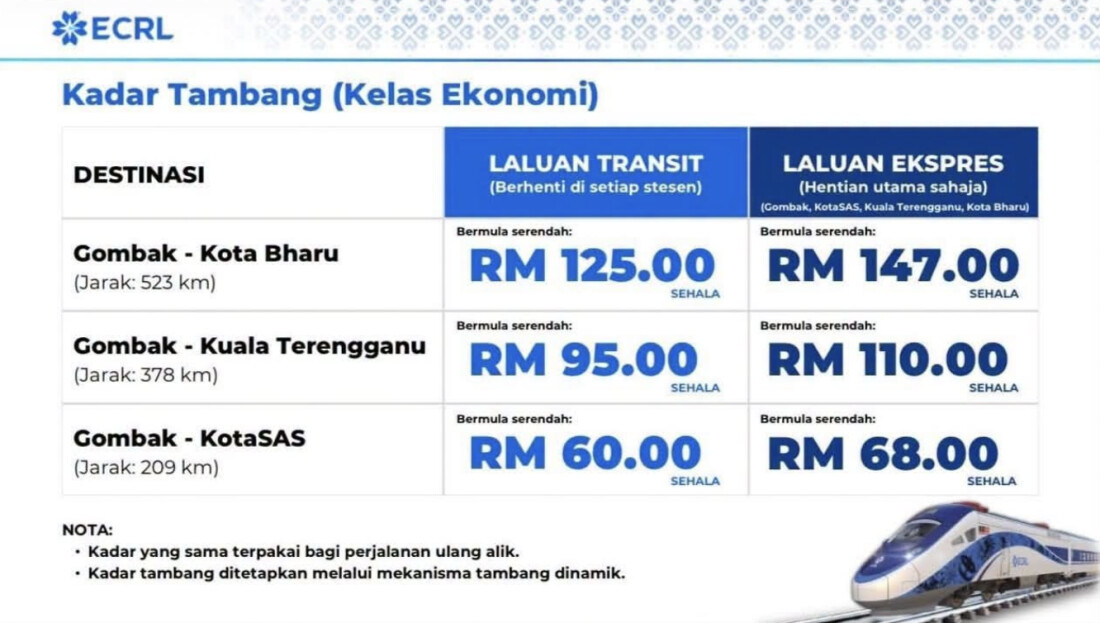
The ECRL's Economy Class fares are finally out, with one-way tickets from Gombak to Kota Bharu starting at RM125 for Transit and RM147 for Express.
Heading somewhere closer? Transit fares start at RM95 to Kuala Terengganu and RM60 to KotaSAS, while Express tickets begin at RM110 and RM68, respectively.
These are starting fares, not fixed prices. The ECRL will use dynamic pricing, and the same starting fares apply in both directions.
But how much would it cost to drive instead?
For our comparison, we're using an estimated 420 km road journey via Gua Musang, alongside two illustrative vehicle-consumption figures.
OUR DRIVING ASSUMPTIONS
PETROL CAR
7L/100 km
Example vehicle types: Perodua Aruz, Proton X50
ELECTRIC CAR
18 kWh/100 km
Example vehicle types: BYD Atto 3, Proton e.MAS 7
Note: Both consumption figures are illustrative mixed-driving estimates, not measured results for the models listed. Actual consumption varies with the vehicle, terrain, speed, driving style and passenger load.
Distance note: The ECRL covers 523 km by rail, compared with our estimated 420 km road journey.
Petrol Vs EV: What Does The Journey Cost?
Let's start with petrol. At an assumed average consumption of 7L/100 km, a car would use approximately 29.4 litres over the 420 km journey.
Based on Malaysian petrol prices effective from 15 to 21 October 2026, that's RM58.51 with BUDI95, or RM135.83 with unsubsidised RON95.
What about an EV?
At an assumed 18 kWh/100 km, our hypothetical EV would consume approximately 75.6 kWh over the same distance.
The tricky part is charging. Home electricity and public DC charging can produce very different bills, even when the vehicle consumes the same amount of energy.
Here's how the numbers stack up.
| Transport / Energy Scenario | One-Way Cost |
|---|---|
| ECRL Transit, 1 full-fare adult | From RM125.00 |
| Petrol, BUDI95 at RM1.99/L | RM58.51 |
| Petrol, unsubsidised RON95 at RM4.62/L | RM135.83 |
| EV, illustrative charging at RM0.50/kWh | RM37.80 |
| EV, illustrative charging at RM1.30/kWh | RM98.28 |
| EV, illustrative charging at RM1.70/kWh | RM128.52 |
Note: ECRL fares are per passenger, while driving figures are estimated energy costs for one vehicle. EV rates are hypothetical, not verified tariffs along the route. Charging losses, tolls, other vehicle expenses and station transfers are excluded. BUDI95 applies only to eligible motorists.
At first glance, RM37.80 makes an EV look like the clear winner. But that assumes all 75.6 kWh of energy can be accounted for at just RM0.50/kWh, before charging losses.
At RM1.70/kWh, the estimated EV energy cost rises to RM128.52, slightly above the ECRL's RM125 starting Transit fare for one adult.
Of course, we're comparing a vehicle's energy expense with a passenger's train ticket, not the complete cost of either journey. And whether an EV can make the trip without charging is another consideration, which we'll get to shortly.
The takeaway? An EV can be inexpensive to run, but how cheaply you charge matters just as much as how efficiently you drive.
Travelling Alone Or With Friends? Here's Where Things Change
There's another factor that can make a much bigger difference than the type of car you're driving.
The number of people travelling.
An ECRL ticket is purchased per passenger. A car's energy expenses, meanwhile, are shared by everyone inside.
Using our baseline assumptions, here's how the comparison changes.
| Travellers | ECRL Transit From | Petrol: BUDI95 | EV: RM1.30/kWh |
|---|---|---|---|
| 1 adult | RM125 | RM58.51 | RM98.28 |
| 2 adults | RM250 | RM58.51 | RM98.28 |
| 4 adults | RM500 | RM58.51 | RM98.28 |
Note: One-way comparison using full-fare adults and constant baseline vehicle energy consumption. Actual consumption may increase with passenger load. EV charging prices are hypothetical. Tolls and other expenses are excluded.
For a solo traveller eligible for BUDI95, our petrol car uses approximately RM66.49 less in fuel than the cheapest ECRL Transit ticket.
Under the RM1.30/kWh EV scenario, the difference is RM26.72.
But bring three more full-fare adults, and the ECRL ticket total rises to RM500.
The car's energy bill doesn't quadruple just because four people are travelling.
ONE CAR, FOUR PASSENGERS
Four ECRL Transit tickets start at RM500 one-way. Sharing a car can make petrol or EV energy expenses substantially cheaper per person, although tolls and other driving costs still matter.
But What If You're Travelling With Children Or Seniors?
Four people travelling to Kota Bharu doesn't necessarily mean four RM125 ECRL tickets.
Take a family of two adults and two children, for example. If both children qualify for MRL's 50% concession, the family's one-way Transit fare could be considerably lower than the cost of four full-fare tickets.
FOUR FULL-FARE PASSENGERS
RM500
4 adults × RM125
TWO ADULTS + TWO ELIGIBLE CHILDREN
RM375
2 × RM125 + 2 × RM62.50
RM125 LESS WITH CHILD CONCESSIONS
Note: Illustrative one-way Transit fares based on the RM125 starting price. Actual prices and concession eligibility are subject to dynamic pricing and applicable terms and conditions.
And children aren't the only passengers eligible for discounted fares.
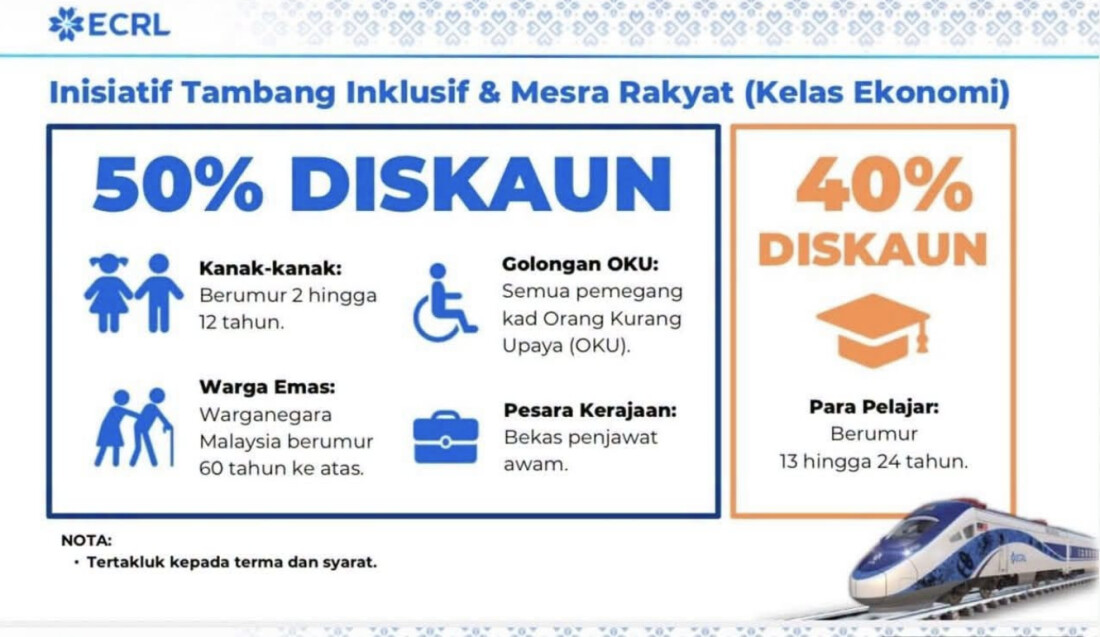
MRL has announced 50% discounts for children aged two to 12, Malaysian senior citizens aged 60 and above, OKU cardholders and government pensioners.
Eligible students aged 13 to 24, meanwhile, receive a 40% discount.
Based on the RM125 starting fare, that works out to an illustrative RM62.50 for a 50% concession ticket, or RM75 for an eligible student.
Does that make the train cheaper than driving? Not necessarily.
Even with concessions, the family's train tickets could cost more than the fuel needed for one shared car under our assumptions. But discounts do narrow the gap, particularly for households with several eligible passengers.
The EV Catch: Can You Make It Without Charging?
Our hypothetical EV consumes approximately 75.6 kWh over 420 km. But can it actually complete the journey without stopping to charge?
That depends on its usable battery capacity, starting charge and real-world efficiency.
Some EVs may have sufficient range under favourable conditions. Others will need a charging stop, especially if sustained highway speeds, terrain or air-conditioning increase consumption.
And unlike a quick petrol stop, DC charging can add time depending on charger availability, the vehicle's charging capabilities and how much energy needs to be added.
Drivers also need to plan where to charge and ensure they can reach a suitable charger with enough battery remaining.
So while an EV may look inexpensive on paper, the real question is whether the journey works comfortably for your particular car.
What About Tolls, Time And Convenience?
A cheaper journey doesn't always mean a better journey. Especially when you're travelling to Kelantan.
Beyond fuel and electricity, driving also involves tolls, servicing, tyre wear and other vehicle expenses. Train passengers, meanwhile, need to factor in transport to Gombak station and getting around after arriving in Kota Bharu.
Then there's the time spent travelling.
The ECRL Express service is expected to complete the Gombak-Kota Bharu journey in approximately four hours, while Transit could take around five hours.
But there's an important distinction: the four-hour journey applies to Express tickets starting at RM147, not the RM125 Transit service.
Our illustrative driving estimate, meanwhile, is around eight hours, depending on traffic, rest stops and road conditions.
And anyone who's experienced balik kampung traffic towards Kelantan knows just how unpredictable that journey can be.
Of course, the ECRL's advertised journey times are station-to-station. Getting to the station, boarding and arranging onward transport will add to the overall travel time.
Still, the train offers something driving doesn't: the freedom to spend those hours doing something other than concentrating on the road.
As we explored in our earlier feature, the ECRL passenger experience is expected to include onboard prayer facilities, reclining seats, luggage storage and connectivity features.
But driving retains one major advantage.
Your car is already there when you arrive.
For travellers visiting relatives, exploring Kelantan or making several stops, having their own vehicle could be a major convenience.
So, Petrol, EV Or Train: Which Actually Wins?
For groups, driving has a substantial advantage in shared energy expenses under our assumptions. Solo travellers, meanwhile, face a more personal trade-off between cost, journey time and convenience.
Here's how the options compare for different travellers.
WHICH OPTION MAKES MORE SENSE?
Families and groups: Driving generally looks more economical on energy expenses alone, particularly when the vehicle is shared.
Solo travellers: The ECRL becomes more appealing if avoiding a long drive matters more than achieving the lowest possible energy cost.
Concession-eligible passengers: Discounted ECRL fares could make the train a more attractive option, although actual savings depend on ticket pricing and eligibility.
Ultimately, the ECRL's biggest selling point might not be the lowest fare. It could be reaching Kota Bharu without spending hours behind the wheel.
And for anyone who's endured a long balik kampung journey, that alone might be worth paying for.
Planning a trip to Kota Bharu? Here are some common questions about ECRL ticket prices, journey times and driving costs.
How much is the ECRL ticket from Gombak to Kota Bharu?
How long does the ECRL take from Gombak to Kota Bharu?
Is driving to Kota Bharu cheaper than taking the ECRL?
Who qualifies for discounted ECRL tickets?
How We Calculated The Costs
This comparison assumes a 420 km road journey via Gua Musang, with petrol consumption of 7L/100 km and EV consumption of 18 kWh/100 km. The ECRL covers 523 km by rail.
Petrol costs use prices effective from 15 to 21 October 2026, while EV charging rates are illustrative. Train fares are per passenger; driving energy costs are per vehicle.
Figures exclude tolls, vehicle expenses, charging losses and station transfers. ECRL fares are starting prices, with actual ticket costs and concessions subject to dynamic pricing and applicable terms.
Written By
Sofea Najmi
A Bachelor of English Language and Literature graduate with an obsession for the finer details. Sofea uses her background in translation to decode the technicalities of automotive innovation. She is dedicated to delivering impactful, meticulously researched articles that provide a narrative far beyond the spec sheet. LinkedIn: https://bit.ly/3C018vv
JPJ Running Numbers
KUALA LUMPUR
VRU5283
SELANGOR
BSU4910
JOHOR
JG215J
PULAU PINANG
PSG5531
PERAK
APM3612
PAHANG
CFJ1632
KEDAH
KGJ5144
NEGERI SEMBILAN
NEM3294
KOTA KINABALU
SJU6126
KUCHING
QAB7794P
Last updated 19 Oct, 2026
Fuel Price
Petrol
RON 95
RM 3.97
+1.38
RON 97
RM 4.90
+1.75
RON 100
RM 7.20
+2.20
VPR
RM 8.23
+2.00
Diesel
EURO 5 B10
RM 5.12
+2.08
EURO 5 B7
RM 5.32
+2.08
Last updated 30 Apr, 2026
Related News
Why Extending The ECRL To Rantau Panjang Could Be A Much Bigger Deal Than It Sounds
The proposed ECRL extension to Rantau Panjang could link Malaysia with Thailand and a wider Asian rail and port network. Here's why it matters.
29-09-2026
Kuantan Welcomes ECRL’s First Trains Ahead of 2027 Operations
The first ECRL electric passenger trains and freight locomotives have arrived in Kuantan as the project moves closer to operations in 2027.
11-02-2026
ECRL Fares To Be Announced Ahead of 2027 Launch
ECRL fares will be disclosed several months prior to the commencement of operations in January 2027, according to Transport Minister.
30-01-2026
ECRL Launch Hinges On System Integration, Jan 2027 Target Maintained
The ECRL remains on schedule, with system integration and testing now the key focus ahead of its planned Jan 2027 launch.
29-01-2026
ECRL First EMU Trains, E-Locos Head To Malaysia For Testing
Malaysia’s East Coast Rail Link gears up as its first EMUs and electric locomotives arrive for testing and future service.
17-12-2025
First ECRL Trains Depart China, Remaining Units Arriving Through 2026
First ECRL trains depart China, with remaining units scheduled to arrive through 2026.
28-11-2025
ECRL Nears Completion with 89% Progress, Operations Set for 2027
ECRL is on track to begin services from Kota Bharu to Gombak in Jan 2027, as construction progress hits 89%.
24-11-2025
ECRL Trains Fully Assembled, Ready for Malaysia
The first batch of trains for the East Coast Rail Link (ECRL) is now ready in Dalian, China.
21-11-2025
Latest News
ECRL Vs Driving To Kota Bharu: Petrol, EV Or Train, Which Costs Less?
ECRL fares to Kota Bharu start at RM125. We compare train tickets with petrol and EV energy costs to see which option makes more sense.
19-10-2026
"We'd Love To Go Back": Mercedes Eyes Sepang Return As F1 Night Race Idea Emerges
Mercedes-AMG Petronas F1 wants to return to Sepang, while Signify says a night race is technically possible. Could Malaysia's next F1 race be after dark?
19-10-2026
RM52,000 In Car Rebates? Sime Motors' 3-Day Sale Is Now On!
Sime Motors' 3-day sale runs from 16 to 18 October 2026 in Ara Damansara, with car rebates up to RM52,000, test drives and special offers.
16-10-2026
RM950 Million From F1 At Sepang. So Why Is Malaysia Still Hesitating?
F1 at Sepang generated nearly RM950 million in economic impact. But a five-year Malaysian GP deal could cost RM1.5 billion. Here's why.
16-10-2026
35 Cars Daily! BYD's New Miri 3S Centre Puts Aftersales In Focus
BYD's new Miri 3S Centre can service up to 35 cars daily. Here's how the latest Sarawak expansion strengthens aftersales support for EV owners.
15-10-2026
Chery Omoda 5 Recall: 600 Cars In 2024, 8,878 In 2026. What Changed?
Chery's Omoda 5 recall covers 8,878 vehicles, compared with 600 in 2024. Here's what changed, what remains unknown and what owners should do.
15-10-2026
BYD Was Supposed To Build Its Own Factory. So Why Inokom Now?
BYD has chosen Inokom for Malaysian CKD assembly after changing its Tanjung Malim plans. Here's why the Kulim facility makes sense.
15-10-2026
GWM Malaysia's Next Big Move Isn't A New Car. It's All About Owners
GWM Malaysia reports 33% delivery growth and over 40 outlets nationwide. Here's what its new Johor and Selangor facilities offer owners.
14-10-2026
Show More
trending_flat
Malaysia First Used Car and EV Consignment Platform
This is the best place to sell your car at true market value. Instead of accepting low dealer trade-ins, we handle everything and connect your car directly to genuine buyers for the highest price.

Understanding CariCarzAutomall Consignment Plan

Approved 200-Check Points Inspection
7 Day Money Back Guarantee

One Year Extended Warranty
No Hidden Charge