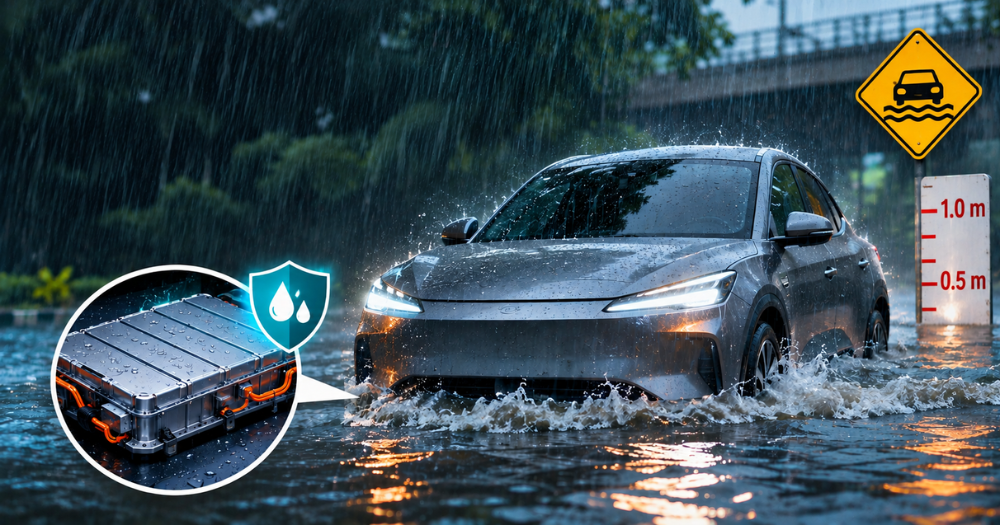
An EV battery is designed to keep water out. So what happens when the entire car ends up underwater? Can the battery survive, or could floodwater cause serious damage?
The answer depends on what the water reaches. A sealed battery pack may remain intact even when other electrical components are damaged. But if floodwater compromises the battery or its electrical connections, the consequences can be far more serious.
- EV batteries are water-resistant, not floodproof. Protective sealing has limits.
- Flood damage varies. The battery may survive even when other electrical systems are affected.
- Don't drive or charge a significantly flooded EV until a qualified professional has assessed it.
Are EV Batteries Really Waterproof?
EV battery packs are housed in protective enclosures designed to resist water intrusion. Some carry Ingress Protection (IP) ratings, which indicate resistance to dust and water under specified testing conditions.
For example, IP67 generally includes temporary immersion testing under defined conditions. It doesn't guarantee protection against prolonged flooding, physical damage or every real-world water exposure.
And even if the battery remains sealed, wiring, connectors and other vehicle electronics may still suffer damage.
What Happens To An EV Battery During A Flood?
The outcome depends on the flood depth, duration of exposure, condition of the battery enclosure and whether water reaches vulnerable electrical components. Broadly, three scenarios are possible.
The Battery Stays Sealed
Floodwater may never reach the battery cells. However, wiring, sensors and other electronics can still be damaged.
Electrical Connections Are Affected
Water reaches vulnerable connectors or electronic components, potentially causing faults or corrosion even when the battery pack remains intact.
Water Enters The Battery Pack
A compromised enclosure may allow internal damage and electrical hazards. In some circumstances, a damaged lithium-ion battery can experience thermal runaway, potentially leading to fire.
These are possible outcomes, not stages that every flooded EV goes through. A vehicle's protective systems may detect certain electrical faults and isolate high-voltage components, but that doesn't guarantee the vehicle is safe afterwards.
Researchers documented different outcomes. Some packs showed no evidence of water entering the main battery compartment, while others showed water intrusion associated with compromised protective features.
The findings, detailed in a technical teardown study hosted by the US National Highway Traffic Safety Administration (NHTSA), show why two flooded EVs may experience very different levels of damage.
What Happens After The Floodwater Recedes?
A flooded EV may look normal once the water recedes, but moisture and contamination can remain inside vulnerable components. Corrosion or electrical faults may develop later, while a compromised high-voltage battery can present additional safety risks.
Tesla's official Model Y submerged-vehicle guidance, for example, advises against operating the vehicle after prolonged submersion until it has been inspected. It also specifies keeping the vehicle at least 15 metres from structures and combustible materials during recovery.
That distance is Tesla-specific guidance, not a universal rule for every EV. Owners should follow their manufacturer's instructions and qualified recovery advice.
Can You Drive An EV Through Floodwater?
Not having a conventional engine air intake doesn't make an EV safe to drive through a flood. Deep water can still damage electronics, enter the cabin or conceal dangerous road conditions.
Some EVs have manufacturer-specified wading limits, but these aren't permission to cross a flooded road. Water depth, currents and hidden hazards can change quickly.
Before travelling during heavy rain, check the official platforms in our guide to flooded roads and road closures in Malaysia.
What Should You Do If Your EV Gets Flooded?
Don't drive, charge or attempt to work on a significantly flood-exposed EV until it has been assessed by a qualified professional. If you notice smoke, unusual heat, hissing or popping sounds, move away and contact emergency services.
- Don't attempt to drive or charge it. Even if the vehicle powers on, hidden electrical damage may remain.
- Move away from warning signs. Smoke, unusual heat or strange sounds require immediate attention. Call 999 in Malaysia if there's an emergency.
- Contact the manufacturer or authorised service centre. Ask for flood-specific inspection and recovery instructions.
- Arrange suitable recovery and storage. Tell the towing operator that the vehicle is electric and has been exposed to floodwater. Follow professional handling and storage guidance.
- Notify your insurer. Document the damage only when safe and confirm the claims procedure before authorising major repairs.
As explained in NHTSA's EV safety guidance, damaged high-voltage batteries may present electrical and fire hazards. Never open the battery enclosure or tamper with orange high-voltage cables yourself.
EV Flood Claims Are Four Times Lower. Are EVs Safer?
Malaysian insurance data has revealed a striking difference in average flood-related claims between EVs and petrol or diesel vehicles.
However, lower average claims don't prove EVs are four times more flood-resistant. The figures reflect insurance claims rather than controlled comparisons under identical flood conditions. PIAM also cautioned that EV claims experience is still developing.
Carz previously covered the findings in its report comparing EV and ICE flood insurance claims.
Does Car Insurance Cover A Flooded EV In Malaysia?
Comprehensive EV insurance doesn't automatically include flood damage. Owners generally need an applicable flood extension, often offered under Special Perils, subject to the policy's terms and limits.
PIAM's reported figures also showed higher flood-coverage uptake among EVs than ICE vehicles. However, owners should check their own policy rather than assume they're protected.
So, Can An EV Really Survive A Flood?
An EV battery may survive a flood, but the vehicle's ability to power on doesn't prove it's safe. Water-resistant engineering can help protect critical components, yet only a proper inspection can establish whether a significantly flood-exposed EV is fit to return to the road.
Frequently Asked Questions
Can an EV battery be damaged by floodwater?
Yes. If water compromises the battery enclosure or electrical connections, it can cause damage and safety hazards. The outcome depends on the vehicle and severity of exposure.
Can I charge my EV after it has been flooded?
Don't charge a significantly flood-exposed EV until a qualified technician has assessed it and confirmed the appropriate next steps.
Can an EV catch fire after flooding?
A damaged high-voltage battery can present a fire risk, including after the water recedes. This doesn't mean every flooded EV will catch fire.
Does comprehensive EV insurance cover flood damage?
Not automatically. Flood protection generally requires a relevant policy extension, often called Special Perils. Check your policy schedule and insurer's terms.