MITI Insists Tough New EV Rules Aren't Just To Protect Proton & Perodua From China Competitors

We are barely over a week into Malaysia's controversial new EV import policy, and the "protectionism" debate is already boiling over. While consumers are furious that the strict RM200k price floor effectively bans cheap, imported China EVs, MITI is stepping up to defend the move.
In a parliamentary exchange with Julau MP Datuk Larry Sng, who questioned why EVs are being policed so aggressively compared to traditional petrol cars, Deputy Minister Sim Tze Tzin laid the cards on the table. The ministry is doubling down on its stance, making it clear that the era of easy imports is over because Malaysia needs to build its own industrial powerhouse, not just act as a passive consumer market.
"We Want an Industrial Base, Not Just a Consumer Market"

Sim explained that the liberal, tax-free environment we enjoyed from 2022 through 2025 was simply "Phase 1", a temporary window to spark early adoption and get charging stations built. Now, Malaysia has transitioned into Phase 2, where the name of the game is localisation.
"The government allows the importation of CBU (fully imported) vehicles — no problem — that is with the purpose of complementing the domestic market supply without undermining the development of the national automotive industry."
— Deputy Minister, Sim Tze Tzin
The harsh reality? The government wants foreign brands to stop just shipping finished cars to our ports. They want them to set up physical Completely Knocked-Down (CKD) assembly lines inside Malaysia so local vendors, parts suppliers, and high-skilled workers actually benefit from the global EV boom.
If we keep importing cheap city-runabouts without forcing local assembly, Malaysia will remain "just a market" instead of building a resilient industrial base.
Read: MITI Breaks Silence: The Truth Behind the '80% Export' Ultimatum
The Comparison Nobody is Talking About: Petrol Cars Have Faced This for Decades

One of the most interesting points Sim raised to counter the "protectionism" narrative is that this type of policy isn't actually new, we’ve just been living in an artificial EV bubble for the last four years.
When you look at the traditional Internal Combustion Engine (ICE) market, the Malaysian government has been using regulatory gatekeepers for decades. Fully imported petrol cars have long been strictly limited to engine capacities of 1,800cc and above to prevent them from directly cannibalizing the local manufacturing ecosystem.
So why are the rules for EVs structured around a pricing floor (RM200k CIF) and motor power (180kW) instead of engine size? Sim pointed out that the two industries are at completely different stages of development, which requires a totally different tax approach.
The Secret Battle Against "Tax Under-Declaration"
This is where the math gets high-stakes. While traditional petrol cars face massive, progressive excise duties based on engine size, fully electric vehicles currently enjoy a flat excise duty rate of only 10%.
Because that 10% tax rate is so incredibly low, it creates a massive loophole for sneaky distributors to "under-declare" the actual cost of their incoming cars at customs, allowing them to pay pennies in taxes.
"With the lower excise duty rate, determining the import value of electric vehicles becomes more critical to ensure that the basis for taxation is accurate to reduce the risk of under-declaration of import values below their actual value."
— Deputy Minister, Sim Tze Tzin
By hard-coding a strict RM200,000 CIF (Cost, Insurance, and Freight) baseline, the government is essentially cutting off tax evasion at the border, ensuring that state tax revenues are safeguarded while the local supply chain gets the breathing room it needs to mature.

MITI is doubling down: the rules are here to stay. While consumers might miss the influx of cheap, imported foreign options, the government is betting big that forcing global brands to build factories locally is the only way to keep Malaysia from becoming an economic bystander in the green transition.
Read: RM300,000 Is The New Entry Level: 10+ Popular EVs That Won't Survive MITI’s July 1 Rule
Written By
Sofea Najmi
A Bachelor of English Language and Literature graduate with an obsession for the finer details. Sofea uses her background in translation to decode the technicalities of automotive innovation. She is dedicated to delivering impactful, meticulously researched articles that provide a narrative far beyond the spec sheet. LinkedIn: https://bit.ly/3C018vv
JPJ Running Numbers
KUALA LUMPUR
VSA4819
SELANGOR
BSV2920
JOHOR
JH7613J
PULAU PINANG
PSH5424
PERAK
APN2134
PAHANG
CFJ4636
KEDAH
KGJ9130
NEGERI SEMBILAN
NEM6571
KOTA KINABALU
SJV2938
KUCHING
QAB704Q
Last updated 23 Nov, 2026
Fuel Price
Petrol
RON 95
RM 3.97
+1.38
RON 97
RM 4.90
+1.75
RON 100
RM 7.20
+2.20
VPR
RM 8.23
+2.00
Diesel
EURO 5 B10
RM 5.12
+2.08
EURO 5 B7
RM 5.32
+2.08
Last updated 30 Apr, 2026
Related News
Malaysia's Proposed EV Levy Explained: Charging Infrastructure, Funding And EV Affordability
Malaysia is studying an EV levy to fund more public chargers. Explore the proposal, infrastructure challenges, Budget 2027 incentives and EV affordability.
18-11-2026
Malaysia's 30,000 EV Charger Target: 7,341 Installed As Of September 2026
Malaysia has 7,341 EV chargers but needs 22,659 more by 2030. Can faster expansion and better rural coverage close the gap?
17-11-2026
The End of Crazy Price Drops: A Market Analyst Says EV Pricing Is Finally Becoming "Rational" In Malaysia
A CIMB Securities automotive analyst reveals why MITI’s new July 1 CBU EV policy will end aggressive price wars and push imported EV showroom prices past RM300k.
25-05-2026
Why BYD’s Surprise Kedah Plant Visit With Sime Motors Is Huge News For EV Buyers
BYD VP Liu Xueliang’s surprise visit to Sime Motors' Inokom plant in Kulim, Kedah hints at a CKD partnership to save affordable EV prices under new MITI rules.
19-05-2026
Should Ministers Drive EVs? 5 Realities Behind The Move To Electrify The Govt Fleet
Is Malaysia's Cabinet going electric? Minister Johari Abdul Ghani discusses the potential switch to an EV official fleet and the RM7 billion subsidy challenge. Read the 5 realities behind the move.
29-04-2026
MITI: Any Bumiputera Company Can Apply For Open AP Starting July
Any Bumiputera company can apply for the open AP permit to engage in vehicle import and sales, says MITI.
19-06-2024
Perodua, Sime Darby Motors Discuss EV Development And EV Battery Recycling With MITI
Tengku Zafrul reveals via X (Twitter) of discussions Between MITI with Perodua and Sime Darby Motors regarding EV development and EV battery recycling.
26-03-2024
MITI Urges BYD to Invest in CKD Production Amidst Tax Exemption Expiry
Amidst the BEV tax exemption expiry in 2025, MITI has encouraged BYD to invest in CKD production here in Malaysia.
23-02-2024
Latest News
BYD Flash Charging Malaysia: 9-Minute Charging, Locations And Compatible EVs
BYD Flash Charging is now in Malaysia. Explore its 1,500 kW chargers, nine-minute charging, locations, compatible EVs and nationwide expansion plans.
20-11-2026
Malaysia Commercial EV Tax Incentives: What's Available And What's Being Proposed
Malaysia is studying sales tax exemptions for electric lorries. Explore existing GITA incentives, Budget 2027 measures and their link to diesel subsidies.
19-11-2026
Malaysia's Temporary 800 kWh Electricity Bill Protection Ends December 2026: What EV Owners Should Know
Malaysia's temporary 800 kWh electricity bill protection ends Dec 31, 2026. Here's what EV owners should know about home charging and electricity tariffs.
19-11-2026
Malaysia's Proposed EV Levy Explained: Charging Infrastructure, Funding And EV Affordability
Malaysia is studying an EV levy to fund more public chargers. Explore the proposal, infrastructure challenges, Budget 2027 incentives and EV affordability.
18-11-2026
Bermaz Auto Ends XPENG Distributorship: What It Means For Malaysia's Automotive Industry
Bermaz Auto ends its XPENG distributorship in Malaysia. Explore its financial significance and the evolving role of local automotive distributors.
18-11-2026
Malaysia's 30,000 EV Charger Target: 7,341 Installed As Of September 2026
Malaysia has 7,341 EV chargers but needs 22,659 more by 2030. Can faster expansion and better rural coverage close the gap?
17-11-2026
EV Flood Damage: Are Electric Car Batteries Waterproof?
Can an EV survive a flood? Learn how floodwater affects electric car batteries, what damage can occur and what Malaysian EV owners should do.
10-11-2026
Thailand EV Import Tax Rises To 35% In 2027 — Malaysia Policy Compared
Thailand raises its EV import tax to 35% in 2027. See how Malaysia's RM200,000 CIF and 180 kW CBU EV rules compare, and what buyers should know.
04-11-2026
Show More
trending_flat
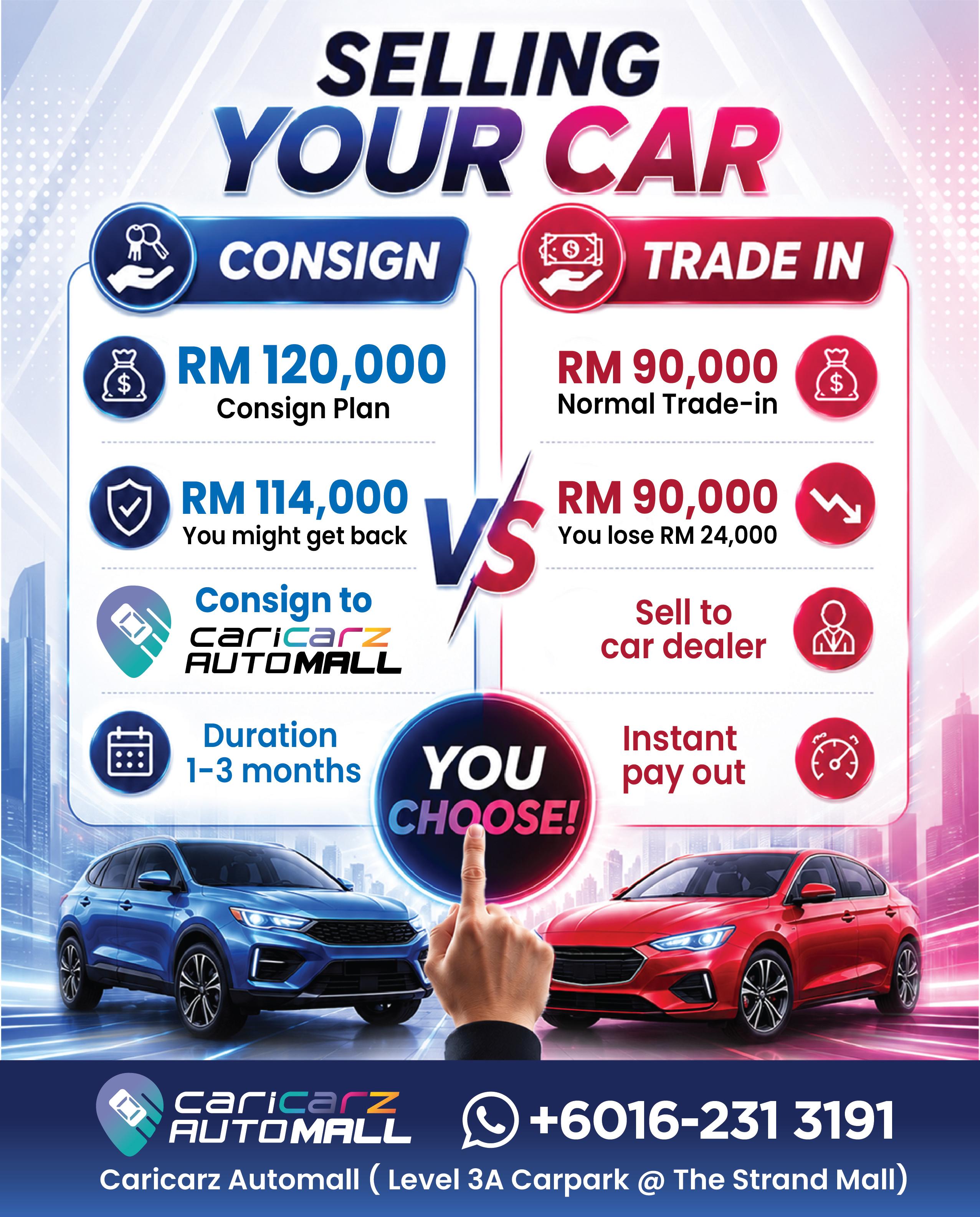
Malaysia First Used Car and EV Consignment Platform
This is the best place to sell your car at true market value. Instead of accepting low dealer trade-ins, we handle everything and connect your car directly to genuine buyers for the highest price.

Understanding CariCarzAutomall Consignment Plan

Approved 200-Check Points Inspection

7 Day Money Back Guarantee

One Year Extended Warranty

No Hidden Charge