Malaysia's Electricity Protection Is Now 800 kWh - How Much Power Does An EV Use Per 100 KM?
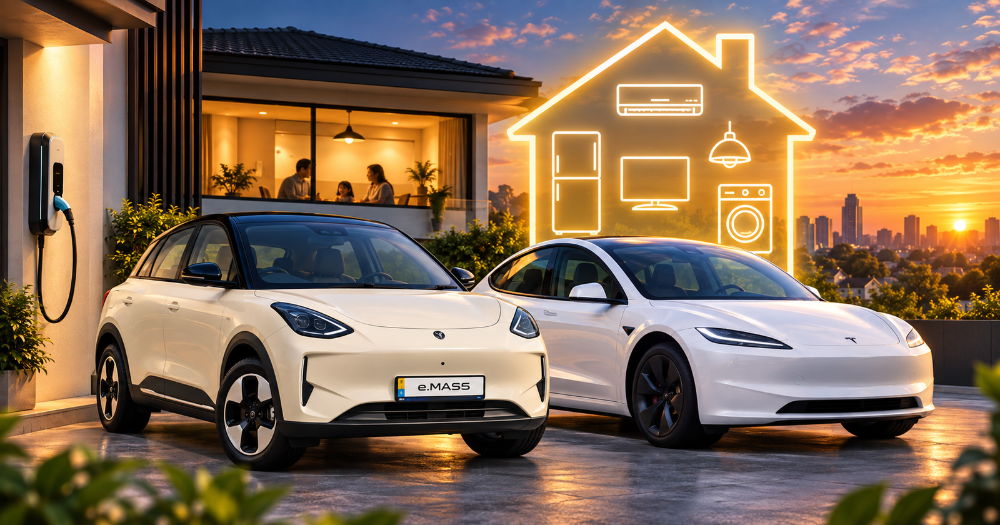
Malaysian households have just been given a little more breathing room on their electricity bills. The government has temporarily raised the protected domestic electricity consumption threshold from 600 kWh to 800 kWh per month, covering electricity consumed from September until Dec 31, 2026.
According to Bernama, domestic users consuming up to 800 kWh a month will be protected through exemptions from the Automatic Fuel Adjustment (AFA), retail charges and Sales and Service Tax (SST).
That's an additional 200 kWh of protected monthly consumption compared to the previous 600 kWh threshold. For Malaysians who charge an EV at home, that raises an interesting question: how much electricity does an EV actually use to cover 100 km?
- Malaysia's protected household electricity threshold has temporarily risen from 600 kWh to 800 kWh.
- That's 200 kWh of additional protected headroom, not 200 kWh of free electricity.
- EV energy consumption can be expressed in kWh/100 km.
- Tesla publishes 13.0 kWh/100 km for the Model 3 RWD and 13.9 kWh/100 km for the Model Y Premium RWD under WLTP.
- Malaysian media tests recorded 10 kWh/100 km in an e.MAS 5 Premium and 11 kWh/100 km in an e.MAS 7 Prime, but these are real-world test results, not Proton's official ratings.
- The 800 kWh threshold covers your whole household, including EV charging.
First, 800 kWh Doesn't Mean Free Electricity
Before we start doing the maths, there's one important distinction. The government is not giving households 800 kWh of free electricity. EV owners aren't receiving an extra 200 kWh of free charging either.
The change raises the monthly consumption threshold for the specified electricity bill protections from 600 kWh to 800 kWh.
The 800 kWh applies to your entire household.
Your air-conditioners, fridge, lights, water heater, washing machine, computers and EV charger all contribute to the same monthly electricity consumption.
So if your home already consumes 500 kWh before charging the car, there's another 300 kWh before total household consumption reaches 800 kWh.
How Much Electricity Does An EV Use Per 100 KM?
With petrol cars, we're accustomed to seeing fuel consumption expressed in litres per 100 km. For EVs, energy consumption can instead be expressed in kilowatt-hours per 100 km, or kWh/100 km.
The principle is straightforward: the lower the number, the less energy the vehicle uses to cover the same distance under those particular test or driving conditions. There is one complication, though. Not every EV manufacturer publishes a directly comparable kWh/100 km figure for its Malaysian models.
So rather than calculate our own "consumption rate" by simply dividing battery capacity by claimed range, we're using published manufacturer figures where available, followed by consumption actually recorded in tests by established Malaysian automotive media.
These Were Malaysia's Most-Registered EVs In August
Why these particular cars? According to JPJ registration data compiled by Paultan, these were Malaysia's seven most-registered EV models in August 2026.
| Rank | EV | Aug 2026 Registrations |
|---|---|---|
| 1 | Proton e.MAS 5 | 4,770 |
| 2 | Tesla Model 3 | 659 |
| 3 | Proton e.MAS 7 | 613 |
| 4 | Tesla Model Y | 507 |
| 5 | Zeekr 7X | 308 |
| 6 | iCaur V23 | 264 |
| 7 | BYD Atto 3 | 252 |
In total, 8,833 EVs were registered in Malaysia in August, accounting for 11.4% of new vehicle registrations that month. The e.MAS 5 alone recorded 4,770 units, meaning one model accounted for roughly 54% of all EV registrations during the month.
So How Much Electricity Do They Actually Use?
This is where the numbers get interesting, but also where we need to distinguish between different types of evidence. Some figures below are official manufacturer consumption ratings. Others were actually recorded during Malaysian media test drives.
Those aren't interchangeable. A controlled WLTP rating gives us a standardised benchmark, while a real-world test tells us what a particular vehicle achieved under a particular set of roads, traffic, speeds and driving conditions.
| EV / Variant | Consumption | What Is It? | 1,000 KM* | 200 kWh* |
|---|---|---|---|---|
| Proton e.MAS 5 Premium | 10.0 kWh/100 km | Malaysian media test | 100 kWh | ~2,000 km |
| Tesla Model 3 RWD | 13.0 kWh/100 km | Official WLTP | 130 kWh | ~1,538 km |
| Proton e.MAS 7 Prime | 11.0 kWh/100 km | Malaysian media test | 110 kWh | ~1,818 km |
| Tesla Model Y Premium RWD | 13.9 kWh/100 km | Official WLTP | 139 kWh | ~1,439 km |
| Zeekr 7X | N/A | No qualifying figure used | - | - |
| iCaur V23 iWD | 22.0 kWh/100 km | Rated consumption, NEDC** | 220 kWh | ~909 km |
| BYD Atto 3 2026 | N/A | No qualifying figure used | - | - |
*The 1,000 km and 200 kWh figures are simple Carz calculations based on the cited consumption figures. They do not account for home-charging losses. Real-world consumption can also change significantly depending on traffic, speed, terrain, weather, air-conditioning use, payload and driving style.
The e.MAS 5 Premium and e.MAS 7 Prime figures are consumption readings recorded during Malaysian media test drives. They are not official Proton consumption ratings and should not be directly ranked against controlled WLTP figures as though the methodology were identical.
**Paultan reports the Malaysian iCaur V23 iWD's rated energy consumption at 22 kWh/100 km alongside its 430 km NEDC-rated range. NEDC and WLTP are different testing standards, so the figure should not be directly compared with WLTP ratings without that caveat.
For the Zeekr 7X and current Malaysian BYD Atto 3, we did not find a sufficiently comparable Malaysian published consumption figure under our sourcing criteria, so we have not calculated one from battery capacity and claimed range.
Because we'd rather leave a number out than manufacture one. Dividing an EV's battery capacity by its claimed driving range can produce a mathematical ratio, but that is not automatically the same thing as a manufacturer's tested or certified energy-consumption figure.
So if we couldn't find a sufficiently defensible published or tested consumption figure, we left it as N/A.
What Does 200 kWh Look Like In EV Terms?
The figures above reveal something interesting. At Tesla's official 13.0 kWh/100 km WLTP figure, a Model 3 RWD would theoretically require around 130 kWh of vehicle energy to cover 1,000 km.
At the 13.9 kWh/100 km official WLTP figure published for the Model Y Premium RWD, 1,000 km works out to around 139 kWh.
100 km: 13 kWh
500 km: 65 kWh
1,000 km: 130 kWh
200 kWh: theoretically ~1,538 km
That doesn't mean the government's threshold change gives a Model 3 owner 1,538 km of free driving. It simply puts the 200 kWh difference between the old and new protected household thresholds into perspective.
And What Have EVs Actually Recorded On Malaysian Roads?
The Proton figures give us another perspective because these weren't calculated from claimed battery capacity and range.
During a PRO-NET-organised Malaysian media drive, Zigwheels Malaysia reported that the trip computer of its e.MAS 5 Premium showed 10 kWh/100 km during its driving. The test involved real Klang Valley running, including Shah Alam, Petaling Jaya and Kuala Lumpur, before the car was also driven towards Genting Highlands.
In a separate Malaysian road test of the e.MAS 7 Prime, the publication reported an average of 11 kWh/100 km on its journey to and from Melaka.
Proton e.MAS 5 Premium: 10 kWh/100 km recorded during Zigwheels Malaysia's drive.
Proton e.MAS 7 Prime: 11 kWh/100 km averaged during Zigwheels Malaysia's Melaka road test.
These are individual real-world media test results, not Proton's official consumption ratings. Different drivers, routes and conditions can produce substantially different results.
So don't interpret those numbers as a promise that every e.MAS 5 will always return 10 kWh/100 km or every e.MAS 7 will achieve 11 kWh/100 km. What they do show is what those particular cars actually recorded under Malaysian driving conditions.
There's Another Catch: Charging Losses
Even vehicle consumption doesn't tell us exactly how much additional electricity will appear on your household meter. That's because not every kWh drawn from the wall ends up stored in the battery. Some energy is lost through the charging process, conversion and battery management.
The amount isn't fixed. It can vary depending on the vehicle, charger, charging power, temperature and other conditions.
Vehicle consumption: Energy used by the EV to travel.
Electricity drawn from home: Energy pulled through your charger, including charging losses.
Your electricity meter sees the second number.
So if an EV's consumption figure suggests it uses 130 kWh of vehicle energy over 1,000 km, that doesn't necessarily mean your household meter will increase by exactly 130 kWh. The amount drawn from the wall can be higher.
Could Your EV Push The House Above 800 kWh?
Absolutely. And this is where your existing household consumption matters more than the EV alone. Let's use 200 kWh of home EV charging simply as an easy example.
Other household use: 300 kWh
EV charging: 200 kWh
TOTAL: 500 kWh
Other household use: 500 kWh
EV charging: 200 kWh
TOTAL: 700 kWh
Other household use: 650 kWh
EV charging: 200 kWh
TOTAL: 850 kWh
Same 200 kWh of EV charging. Very different outcome. Homes A and B remain below 800 kWh in these examples, while Home C crosses the threshold. That's why asking whether 200 kWh is enough for an EV only tells half the story.
The more important question is: how much electricity was your household already using before you plugged the car in?
So, What Does The 800 kWh Threshold Mean For EV Owners?
For households that charge an EV at home, moving the protected threshold from 600 kWh to 800 kWh provides meaningfully more room before reaching the new limit.
And the consumption figures we've found help put that additional 200 kWh into perspective. A Model 3 RWD, for example, has an official WLTP consumption figure of 13.0 kWh/100 km. At that rate, 1,000 km represents around 130 kWh of vehicle energy.
But that's still not the same thing as saying an EV owner can drive 1,000 km and add exactly 130 kWh to the household electricity bill. Real-world efficiency varies, and home charging also introduces energy losses.
The jump from 600 kWh to 800 kWh doesn't give EV owners 200 kWh of free charging.
But when some EVs consume roughly the low teens of kWh for every 100 km under published or recorded conditions, another 200 kWh of protected household headroom can be significant in EV terms.
Just remember: your EV shares that 800 kWh with everything else in your house, and the electricity drawn from the wall will also include charging losses.
FAQ
Is the government giving households 800 kWh of free electricity?
No. The government has temporarily raised the monthly consumption threshold for specified electricity bill protections from 600 kWh to 800 kWh.
Does that mean households get an extra 200 kWh of free electricity?
No. The 200 kWh is simply the difference between the previous 600 kWh threshold and the new 800 kWh threshold.
How much electricity does an EV use per 100 km?
It depends on the vehicle and driving conditions. As examples, Tesla publishes 13.0 kWh/100 km WLTP for the Model 3 RWD and 13.9 kWh/100 km for the Model Y Premium RWD. Malaysian media tests have recorded different figures for other EVs under real-world conditions.
Can charging an EV add 200 kWh to my monthly electricity consumption?
Yes. The amount depends on how far you drive, your EV's efficiency and energy lost during charging.
Does the 800 kWh threshold apply separately to my EV?
No. It applies to total household electricity consumption, including appliances, air-conditioning and EV charging.
How long does the 800 kWh protection apply?
The announced measure covers electricity consumed from September until Dec 31, 2026.
Written By
Sofea Najmi
A Bachelor of English Language and Literature graduate with an obsession for the finer details. Sofea uses her background in translation to decode the technicalities of automotive innovation. She is dedicated to delivering impactful, meticulously researched articles that provide a narrative far beyond the spec sheet. LinkedIn: https://bit.ly/3C018vv
JPJ Running Numbers
KUALA LUMPUR
VRQ2895
SELANGOR
BST7265
JOHOR
JE3258J
PULAU PINANG
PSF5773
PERAK
APL4891
PAHANG
CFH7448
KEDAH
KGJ1329
NEGERI SEMBILAN
NEL8562
KOTA KINABALU
SJU1428
KUCHING
QAB5707P
Last updated 18 Sep, 2026
Fuel Price
Petrol
RON 95
RM 3.97
+1.38
RON 97
RM 4.90
+1.75
RON 100
RM 7.20
+2.20
VPR
RM 8.23
+2.00
Diesel
EURO 5 B10
RM 5.12
+2.08
EURO 5 B7
RM 5.32
+2.08
Last updated 30 Apr, 2026
Related News
EV 'Fuel' Hike: How To Use TNB’s Off-Peak Rates To Dodge The Upcoming August Surcharge
Electricity bills are rising. As the TNB AFA rate flips to a +1.38 sen surcharge in May 2026, find out how to dodge the upcoming +3.93 sen spike using the Time of Use (ToU) scheme and the 600kWh exemption.
08-05-2026
Pekema Partners Aquateak Energy To Establish SenangCas
Newly established SenangCas, a joint venture between Pekema and Aquateak Energy, enters local EV charging operators space.
09-07-2025
ChargeSini, Sunway And Huawei Enter Tri-Party MoU Agreement
ChargeSini, Sunway, and Huawei formalises tri-party MoU agreement at Malaysia Autoshow 2024 (MAS 2024) to accelerate EV charging infrastructure development.
29-05-2024
ChargeSini and Charge+ Largest EV Charging Roaming Agreement - Malaysia & Singapore
ChargeSini enters roaming partnership with Singapore’s Charge+ to offer greater convenience for EV performing cross-border travels.
05-04-2024
Tint With Raytech Films And Get 500 FREE ChargeSini Credits!
Get rewarded with 500 FREE ChargeSini credits - worth RM500 - by tinting your vehicle at any Raytech Films outlet today!
04-03-2024
Wireless EV Chargers - The Future Of EV Charging?
Wireless EV Charging technology is getting a lot of limelight of late, and it could prove to be the future of EV chargers.
22-02-2024
EV - Maximising Your Drive Time By Minimising Your Charge Time!
EV users need to educate themselves on their EVs’ charging characteristics to benefit from faster charging speed at lower cost.
14-02-2024
EV Charging Desert! Who To Blame - Government or CPOs?
To date, just 29 locations house 51 EVCB with 50 kW or greater charging outputs along the Malaysian Highway network; East Coast routes remain a charging desert!
08-02-2024
Latest News
Could An EV Really Work As A Malaysian Police Car? PDRM Is Finding Out
PDRM is testing the Proton e.MAS 5, e.MAS 7 EV and e.MAS 7 PHEV to see whether electrified vehicles could work for Malaysian police duties.
18-09-2026
Malaysia's Electricity Protection Is Now 800 kWh - How Much Power Does An EV Use Per 100 KM?
Malaysia's electricity protection threshold is now 800 kWh. Here's how much electricity popular EVs use per 100 km and what the extra 200 kWh means.
18-09-2026
17 New Mercedes Models Are Coming To Malaysia In 2027 - Here's What We Know
Mercedes-Benz Malaysia plans 17 new models for 2027, with most set for local assembly in Pekan. Here's what we know about its ICE and EV plans.
17-09-2026
Perodua QV-E Now At RM53,499 Vs Proton e.MAS 5: Which Makes More Sense?
Perodua QV-E now starts at RM53,499 with BaaS under its Malaysia Day promo. See how it compares with the Proton e.MAS 5 on price, range, charging and features.
16-09-2026
Yes, Tan Chong Is Involved In Perodua's EV. Here's What It's Actually Doing
Tan Chong has signed a three-year agreement to support Perodua's EV production with ED coating, painting and assembly-line services.
15-09-2026
BYD Has A New Plan For Malaysian-Made Cars, And It's Not Tanjung Malim
BYD has dropped its Tanjung Malim plant plan but says Malaysian CKD remains on track, with talks with an unnamed local partner at an advanced stage.
11-09-2026
Malaysia's EVs Are Growing Fast. The Chargers? Not So Much
Malaysia's EV registrations are surging, with 122,286 registered by July 2026. But can the country's 6,416 public EV chargers keep up?
10-09-2026
Could The Proton e.MAS 7 PHEV Get 230 KM EV Range And AWD Next? Its China Twin Says Maybe
The Proton e.MAS 7 PHEV's Geely twin is getting a larger 40.06 kWh battery, around 230 KM WLTP EV range and AWD. Could Malaysia get them too?
10-09-2026
Show More
trending_flat