MITI Won’t Cap EV Charging Rates: What "No Price Control" Means For Malaysian Drivers

-full.jpg)
If you’ve been thinking about swapping your petrol car for an electric vehicle (EV), or if you already drive one, the cost of plugging in on long road trips is probably top of mind. While petrol prices like RON95 are heavily regulated in Malaysia, public EV charging is taking a very different route.
In a written parliamentary reply, the Ministry of Investment, Trade and Industry (MITI) confirmed that the government has not introduced any price control mechanism for public EV charging services, and currently has no plans to do so. Instead, charging point operators (CPOs) are free to set their own rates based on commercial considerations.
So, will this free-market approach keep charging prices fair, or are drivers about to face steep highway bills? Here is a breakdown of what MITI announced and what it actually means for your daily drive.
⚡ TL;DR Summary: MITI's EV Charging Policy
- No Price Caps: MITI confirms public EV charging fees will remain unregulated to encourage CPO competition and private investment.
- 6,400+ Chargers Nationwide: As of May 31, 2026, Malaysia has 6,416 public chargers installed.
- The Fast-Charging Gap: Slower AC chargers still dominate (66.6%), while DC fast-chargers make up 33.4%.
- Massive Regional Disparity: 96% of all public chargers are in Peninsular Malaysia, leaving just 208 in Sarawak and 32 in Sabah.
- Safety Is Still Regulated: While prices are free-market, safety, technical standards, and licensing remain strictly enforced by the Energy Commission (ST) and local councils.
Why Isn't The Government Regulating EV Charging Prices?
Responding to a query in the Dewan Negara from Senator Robert Lau Hui Yew regarding price controls and oversight, MITI explained that allowing CPOs to set their own rates is a deliberate strategy.
By maintaining a market-driven environment, the government aims to:
- Attract Private Investment: Encourage companies to fund expensive charging infrastructure without fear of rigid price ceilings.
- Foster Healthy Competition: Drive CPOs to compete on charging speeds, station reliability, location convenience, and competitive pricing.
- Expand Network Rapidly: Accelerate the rollout of fast-charging stations along major highways and rural routes.
"This approach is intended to encourage private sector investment and foster healthy competition in the provision of EV charging services."
— MITI
The Reality Check: Where Malaysia Stand On EV Chargers Right Now
Along with the pricing policy, MITI shared updated figures detailing the nation’s public charging infrastructure as of May 31, 2026:
The East Malaysia Charging Divide
The data highlights a massive gap between Peninsular Malaysia and East Malaysia. With 96% of chargers concentrated in the Peninsular, drivers in Sabah and Sarawak face severe infrastructure hurdles, relying on a combined total of just 240 public plugs across both states.
Read: The Govt Wants 30,000 EV Chargers By 2030, But We Barely Hit Half Of Our Last Target
📍 Infrastructure Reality Check:
With only 32 public chargers in Sabah and 208 in Sarawak, East Malaysia accounts for just 4% of the nation's total EV plugs. Cross-state road trips in Borneo still require careful planning!
Does "No Price Control" Mean Zero Government Oversight?

Not quite! While CPOs can set per-kWh or per-minute fees based on commercial factors, safety and technical operations remain tightly regulated.
All public EV charging installations must comply with strict licensing, technical, and safety guidelines overseen by:
- Ministry of Investment, Trade and Industry (MITI)
- Energy Commission (ST)
- Local Municipal Councils (PBTs)
⚡ TL;DR Summary: MITI's EV Charging Policy
- No Price Caps: MITI confirms public EV charging fees will remain unregulated to encourage CPO competition and private investment.
- 6,400+ Chargers Nationwide: As of May 31, 2026, Malaysia has 6,416 public chargers installed.
- The Fast-Charging Gap: Slower AC chargers still dominate (66.6%), while DC fast-chargers make up 33.4%.
- Massive Regional Disparity: 96% of all public chargers are in Peninsular Malaysia, leaving just 208 in Sarawak and 32 in Sabah.
- Safety Is Still Regulated: While prices are free-market, safety, technical standards, and licensing remain strictly enforced by the Energy Commission (ST) and local councils.
Furthermore, the government coordinates ecosystem development through the National EV Task Force and the National EV Steering Committee (chaired by the Deputy Prime Minister). MITI added that ongoing efforts with Tenaga Nasional Bhd (TNB) and the Energy Commission continue to monitor market conditions to ensure charging fees remain fair and competitive.
Read: KL Hits 160% While Perlis Is At 4%? A Look At The Huge EV Charger Gap Across Malaysia
What This Means For You: Is Driving An EV Still Worth It?

Without a price cap, public charging rates can range anywhere from RM1.00 to RM1.80 per kWh for high-speed DC fast charging, depending on the operator and location.
💡 Smart Wallet Tip:
To keep your daily commute ultra-cheap, rely on home AC charging for 90% of your power. Use public DC fast chargers mainly for long-distance highway road trips!
Here is how to navigate an unregulated market:
- Home Charging Is Still King: If you charge your EV at home overnight using standard TNB residential tariffs (~RM0.22 to RM0.57 per kWh), driving an EV remains significantly cheaper than paying for petrol.
- Public Fast Charging Is For Road Trips: Treat public DC fast chargers like premium highway conveniences. While fast-charging on highways costs more, it saves crucial time when traveling interstate.
- Shop Around via Apps: Since CPOs compete freely, using EV aggregator apps allows you to compare rates across nearby stations before plugging in.
❓ Frequently Asked Questions: EV Charging Rates
Why isn't the Malaysian government capping public EV charging prices?
Does "no price control" mean EV charging operators are completely unregulated?
How many public EV chargers are available in Malaysia right now?
Is driving an EV still cheaper than a petrol car without regulated charging fees?
How many EV chargers are located in Sabah and Sarawak?
Written By
Sofea Najmi
A Bachelor of English Language and Literature graduate with an obsession for the finer details. Sofea uses her background in translation to decode the technicalities of automotive innovation. She is dedicated to delivering impactful, meticulously researched articles that provide a narrative far beyond the spec sheet. LinkedIn: https://bit.ly/3C018vv


JPJ Running Numbers
KUALA LUMPUR
VRP8406
SELANGOR
BST6492
JOHOR
JE1674J
PULAU PINANG
PSF5019
PERAK
APL4364
PAHANG
CFH7180
KEDAH
KGJ732
NEGERI SEMBILAN
NEL8145
KOTA KINABALU
SJU957
KUCHING
QAB5503P
Last updated 15 Sep, 2026
Fuel Price
Petrol
RON 95
RM 3.97
+1.38
RON 97
RM 4.90
+1.75
RON 100
RM 7.20
+2.20
VPR
RM 8.23
+2.00
Diesel
EURO 5 B10
RM 5.12
+2.08
EURO 5 B7
RM 5.32
+2.08
Last updated 30 Apr, 2026
Latest News

BYD Has A New Plan For Malaysian-Made Cars, And It's Not Tanjung Malim
BYD has dropped its Tanjung Malim plant plan but says Malaysian CKD remains on track, with talks with an unnamed local partner at an advanced stage.
11-09-2026

Malaysia's EVs Are Growing Fast. The Chargers? Not So Much
Malaysia's EV registrations are surging, with 122,286 registered by July 2026. But can the country's 6,416 public EV chargers keep up?
10-09-2026

Could The Proton e.MAS 7 PHEV Get 230 KM EV Range And AWD Next? Its China Twin Says Maybe
The Proton e.MAS 7 PHEV's Geely twin is getting a larger 40.06 kWh battery, around 230 KM WLTP EV range and AWD. Could Malaysia get them too?
10-09-2026
BYD Malaysia's Next Move Is Coming – Tanjung Malim Or Inokom?
BYD says its next Malaysia move will be revealed within a week. Could its EVs be assembled at Tanjung Malim or Sime Motors' Inokom plant in Kulim?
07-09-2026
Japan Rebadging A Malaysian EV? How Daihatsu Could Use Perodua’s QV-E Platform
Will Daihatsu rebadge Perodua’s QV-E? Inside the historic MITI talks as Japan looks to adopt Malaysia's homegrown EV platform technology.
02-09-2026
One App, More Chargers: ChargeSini and Gentari Roaming Goes Live
Access Gentari EV chargers directly on the ChargeSini app. Discover roaming integration features, real-time bay availability, and seamless payments in one place.
02-09-2026
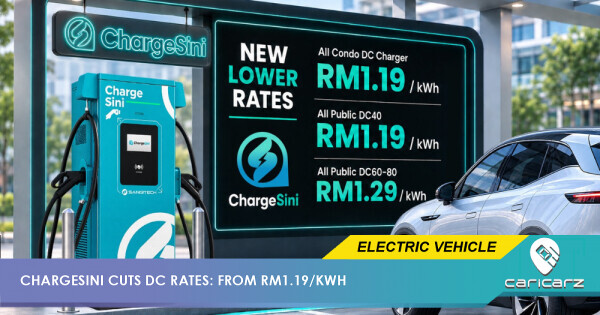
ChargeSini Slashes DC Fast Charging Rates Across Malaysia To Accelerate Nationwide EV Adoption
ChargeSini slashes DC fast charging rates in Malaysia down to RM1.19/kWh. Check out the new revised tariffs for public DC40, DC60, DC80, and condo chargers.
01-09-2026
640km Range & 12-Min Charge: Malaysia’s First Homegrown EV Battery The Key To Affordable EVs
Malaysia launches local production of its 640km graphene EV battery in Sepang! See how GMSB's 12-minute fast-charging cells could make EVs cheaper.
28-08-2026
Show More
trending_flat