Ex-MITI Deputy Says Poor Communication Sparked Public Anger Over RM200k EV Rule


When the Ministry of Investment, Trade and Industry (MITI) strictly enforced new regulations on fully imported (CBU) electric vehicles, mandating a minimum Cost, Insurance, and Freight (CIF) value of RM200,000 and a power output threshold of at least 180 kW (245 PS), the public reaction was swift and furious.
To the average Malaysian car buyer, the rules felt like a blatant return to 1990s-style protectionism. It appeared as though the government was intentionally pricing out affordable imported Chinese EV, to shield upcoming national EV projects from Proton and Perodua.
However, former Deputy Investment, Trade and Industry Minister Dr. Ong Kian Ming says the public outrage isn’t necessarily because the policy itself is bad, but because the government failed miserably at communicating its real purpose.
Speaking at the CGS International ESG and Sustainability Conference 2026, Dr. Ong highlighted that while protecting national carmakers is an obvious outcome, MITI completely omitted a far more critical narrative: safeguarding Malaysia’s multi-billion ringgit local auto-parts manufacturing ecosystem.
The "1990s Protectionism" Trap
Malaysia boasts one of the strongest automotive supply chains in Southeast Asia. According to Dr. Ong, Malaysia ranks second in ASEAN for its automotive parts ecosystem, exporting significantly more in components than finished vehicles.

Taylor’s University adjunct professor and former deputy investment, trade and industry (MITI) minister Dr Ong Kian Ming
"If you look at Vietnam, they’re trying to produce their own car industry and go into EVs, but they can only probably produce 15% to 20% of their parts. Whereas for Malaysia and Thailand, we can go up to 80%," Dr. Ong explained.
When foreign manufacturers flood a market with cheap, fully-assembled CBU units from overseas factories, local Malaysian parts manufacturers get left out completely. By raising the barrier for CBU imports, MITI intended to push global giants like BYD to partner with local assembly plants (CKD), ensuring local factory workers and parts vendors get a piece of the pie.
However, because MITI failed to effectively articulate this economic reality, the public only saw one thing: the government making affordable cars expensive again.

"I think this is where the communications part is actually very important. When MITI announced these policies, there was no counter-narrative to explain how they would help local auto parts players who contribute significantly to our industry," Dr. Ong added.
Read: MITI Insists Tough New EV Rules Aren't Just To Protect Proton & Perodua From China Competitors
The Thailand Warning & The Monopoly Risk
The policy push wasn't created in a vacuum. Regulators watched closely as BYD flooded the Thai auto market with 150,000 units, disrupting local traditional manufacturing before establishing massive local operations. Fearing similar market chaos, Malaysian authorities rushed to erect safeguards.
While Dr. Ong agrees that encouraging local assembly (CKD) is necessary to protect domestic investments, he warned that policy execution must not backfire on consumers. He stressed that restricting lower-end imports shouldn't result in a market duopoly where only one or two national brands control the affordable EV segment under RM100,000.
"My personal preference is actually to allow CKD competition below RM200,000 and not allow EVs priced at RM100,000 and below to be monopolised by one or two players," he stated, emphasizing that if Malaysia wants true EV adoption, government policies must balance local industry survival with healthy consumer choice.
Source: NST
Read: After RM3.3B In Forgone Taxes, MITI Signals End Of 'Free Ride' As New EV Levy Studied
Read: "Don't Just Come Here To Sell Cars": MITI Minister Demands EV Brands Help Build Chargers In Malaysia
Written By
Sofea Najmi
A Bachelor of English Language and Literature graduate with an obsession for the finer details. Sofea uses her background in translation to decode the technicalities of automotive innovation. She is dedicated to delivering impactful, meticulously researched articles that provide a narrative far beyond the spec sheet. LinkedIn: https://bit.ly/3C018vv


JPJ Running Numbers
KUALA LUMPUR
VSA4754
SELANGOR
BSV2914
JOHOR
JH7593J
PULAU PINANG
PSH5414
PERAK
APN2099
PAHANG
CFJ4632
KEDAH
KGJ9084
NEGERI SEMBILAN
NEM6562
KOTA KINABALU
SJV2938
KUCHING
QAB701Q
Last updated 22 Nov, 2026
Fuel Price
Petrol
RON 95
RM 3.97
+1.38
RON 97
RM 4.90
+1.75
RON 100
RM 7.20
+2.20
VPR
RM 8.23
+2.00
Diesel
EURO 5 B10
RM 5.12
+2.08
EURO 5 B7
RM 5.32
+2.08
Last updated 30 Apr, 2026
Related News

Rafizi Defends “Surprise” Fuel Price Hike Statement
Rafizi reiterates that government's decision with sudden price announcements prevent traders from hiking the prices of goods.

12-07-2024

Rafizi: RON 95 Price Increment Would Be Sudden; Ong: This Would Provoke Public Backlash
Ong Kian Ming criticises Rafizi for claiming that RON95 fuel subsidy would be removed abruptly, similar to diesel.
01-07-2024
Latest News
BYD Flash Charging Malaysia: 9-Minute Charging, Locations And Compatible EVs
BYD Flash Charging is now in Malaysia. Explore its 1,500 kW chargers, nine-minute charging, locations, compatible EVs and nationwide expansion plans.
20-11-2026
Malaysia Commercial EV Tax Incentives: What's Available And What's Being Proposed
Malaysia is studying sales tax exemptions for electric lorries. Explore existing GITA incentives, Budget 2027 measures and their link to diesel subsidies.
19-11-2026
Malaysia's Temporary 800 kWh Electricity Bill Protection Ends December 2026: What EV Owners Should Know
Malaysia's temporary 800 kWh electricity bill protection ends Dec 31, 2026. Here's what EV owners should know about home charging and electricity tariffs.
19-11-2026
Malaysia's Proposed EV Levy Explained: Charging Infrastructure, Funding And EV Affordability
Malaysia is studying an EV levy to fund more public chargers. Explore the proposal, infrastructure challenges, Budget 2027 incentives and EV affordability.
18-11-2026
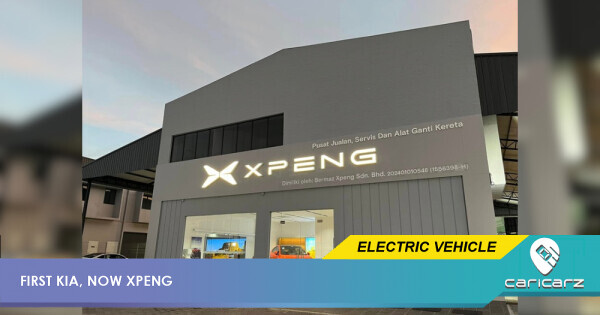
Bermaz Auto Ends XPENG Distributorship: What It Means For Malaysia's Automotive Industry
Bermaz Auto ends its XPENG distributorship in Malaysia. Explore its financial significance and the evolving role of local automotive distributors.
18-11-2026
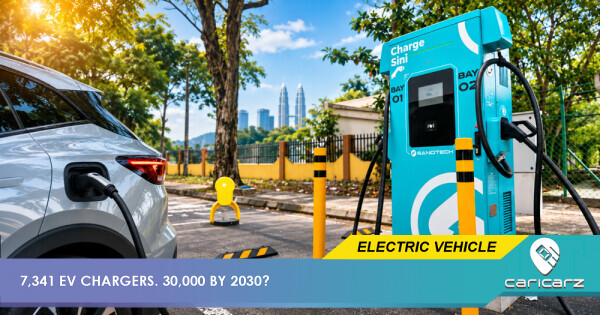
Malaysia's 30,000 EV Charger Target: 7,341 Installed As Of September 2026
Malaysia has 7,341 EV chargers but needs 22,659 more by 2030. Can faster expansion and better rural coverage close the gap?
17-11-2026

EV Flood Damage: Are Electric Car Batteries Waterproof?
Can an EV survive a flood? Learn how floodwater affects electric car batteries, what damage can occur and what Malaysian EV owners should do.
10-11-2026

Thailand EV Import Tax Rises To 35% In 2027 — Malaysia Policy Compared
Thailand raises its EV import tax to 35% in 2027. See how Malaysia's RM200,000 CIF and 180 kW CBU EV rules compare, and what buyers should know.
04-11-2026
Show More
trending_flat
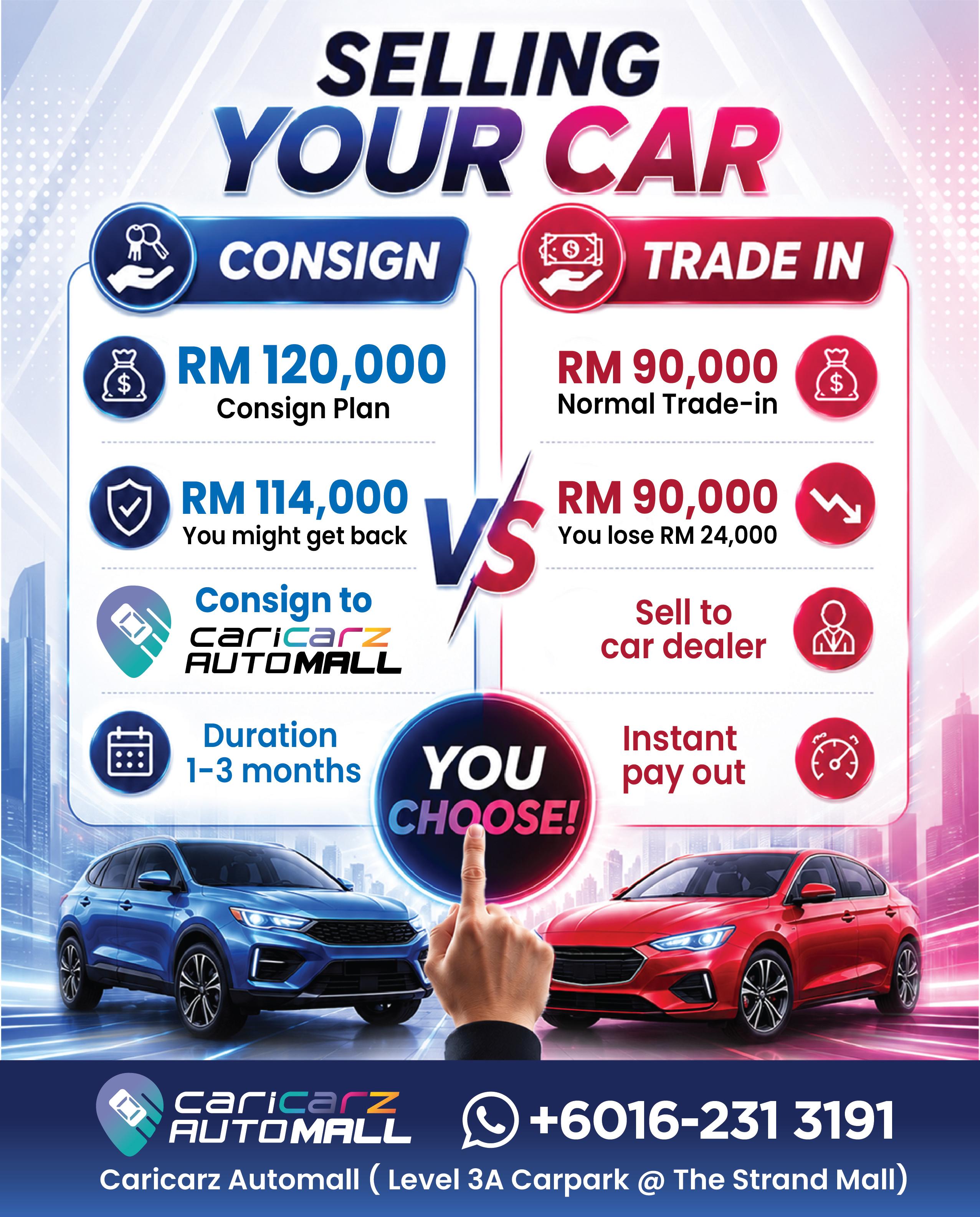
Malaysia First Used Car and EV Consignment Platform
This is the best place to sell your car at true market value. Instead of accepting low dealer trade-ins, we handle everything and connect your car directly to genuine buyers for the highest price.

Understanding CariCarzAutomall Consignment Plan

Approved 200-Check Points Inspection

7 Day Money Back Guarantee

One Year Extended Warranty

No Hidden Charge
