Malaysian car buyers arguably have more choices today than ever before. Beyond familiar names like Toyota and Honda, newer players such as BYD, Chery, Jaecoo, Jetour and GWM have rapidly expanded the number of cars Malaysians can choose from.
Yet two very familiar names still dominate.
According to the latest JPJ registration data published on data.gov.my, Perodua recorded 219,559 new registrations from January to August 2026, while Proton registered another 135,169.
MALAYSIA, JAN-AUG 2026
62.6%
Proton and Perodua combined for 354,728 out of 566,616 new car registrations.
In other words, nearly two out of every three new cars registered in Malaysia so far this year wear either a Proton or Perodua badge. That dominance isn't entirely new either. In our earlier mid-year Malaysian market report, the two national brands already commanded 62.6% of registrations during the first half of 2026.
More importantly, the latest JPJ numbers show that nine of Malaysia's 10 most-registered models from January to August come from Proton or Perodua.
TL;DR
Proton + Perodua account for 62.6% of new car registrations from Jan-Aug 2026.
9 of Malaysia's top 10 models are Proton or Perodua.
Both brands remain strongest where Malaysian volume is deepest: affordable mainstream cars.
Huge sales and service networks give them an ownership advantage newer rivals need time to replicate.
Chinese brands are growing quickly, but their first big disruption may be hitting other non-national marques harder than Proton and Perodua.
Look at Malaysia's most-registered cars and one thing becomes obvious: the real volume is still concentrated around practical, relatively affordable models.
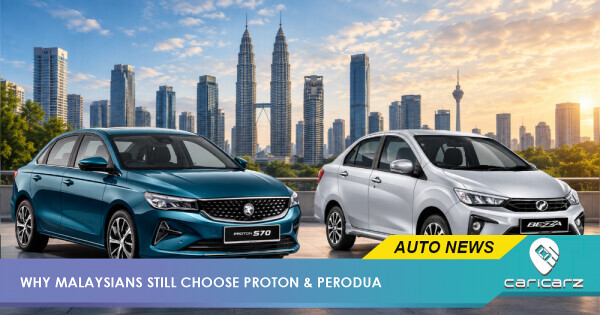
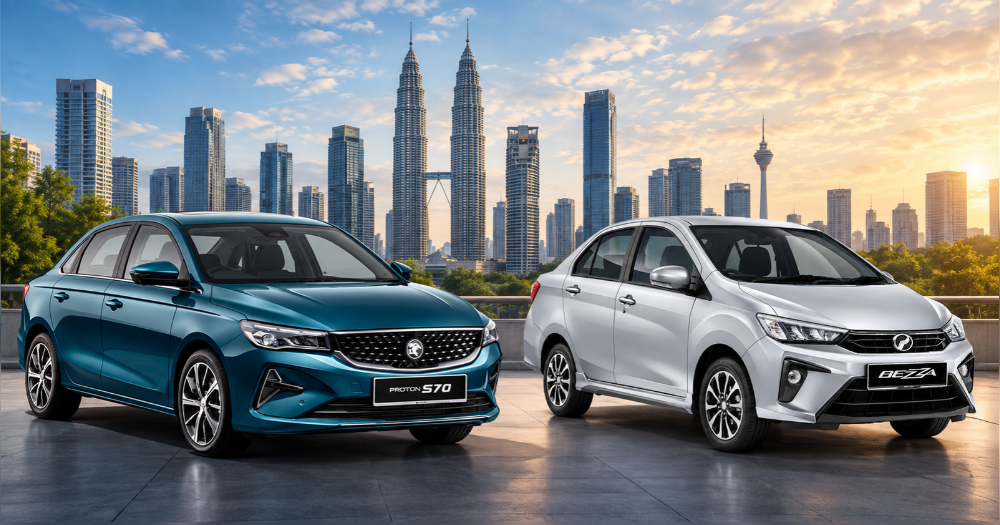
These aren't niche products. The Bezza, Saga, Axia, Myvi and Alza sit right in the heart of Malaysia's mass market as daily commuters, first cars and family vehicles. And that's exactly where Proton and Perodua remain particularly difficult to beat.
THE BIG DIFFERENCE
Newer brands can grow rapidly without immediately taking Proton and Perodua's core buyers if much of that growth happens in different price segments.
This helps explain how two things can be true at the same time: Chinese brands are growing rapidly in Malaysia, yet Proton and Perodua remain dominant.
In fact, a JPJ-based analysis by Paultan found that Chinese marques grew from just 0.08% of Malaysian registrations in 2022 to 7.61% in 2025, before reaching 8.92% during the first five months of 2026. Fast growth, certainly. But not yet enough to break the national brands' grip on Malaysia's highest-volume segments.
Government policy also helps preserve that position. In its March 2026 clarification on BYD's proposed local assembly operations, MITI confirmed a minimum on-the-road price of RM100,000 for BYD’s locally assembled vehicles, explicitly citing the preservation of market space for Proton and Perodua.
That does not amount to a blanket ban on cheaper foreign-brand cars. MITI distinguishes new automotive investments from those using existing local assembly facilities. But it does show why more brands entering Malaysia does not automatically mean more direct competition at Bezza, Axia or Saga prices.
Price and policy aren't the entire story, Proton and Perodua also have something newer entrants simply cannot build overnight:a huge nationwide ownership ecosystem.
PERODUA
194
Sales outlets
209
Service centres
PROTON
195
Sales outlets
178
Integrated 3S / 4S outlets
Perodua previously reported having 194 sales outlets and 209 service centres nationwide. Proton, meanwhile, said its network had reached 195 sales outlets as of June 2026, including 178 integrated 3S and 4S locations. That matters when you're buying something you may keep for seven, nine or even 10 years.
Where's the nearest workshop? How convenient will routine servicing be? What happens if something goes wrong?
A newcomer can launch an impressive car relatively quickly. Building that sort of nationwide ownership infrastructure takes much longer. There's another reason the old explanation of Malaysians simply "buying local" feels increasingly incomplete.
The products themselves have become more competitive.
Proton e.MAS 5
Proton recorded its strongest first-half performance in 15 years in 2026, delivering 100,346 vehicles during the first six months of the year. And its growth isn't coming from the Saga alone. The latest JPJ rankings place the S70, e.MAS 5 and X50 among Malaysia's 10 most-registered models from January to August.
Perodua, meanwhile, continues to occupy four of the top five positions with the Bezza, Axia, Myvi and Alza.
Choosing a national brand today therefore doesn't necessarily mean choosing Malaysia's simplest car. Both manufacturers now cover a much broader spread of segments and technologies than they once did.
ONE PARTICULARLY INTERESTING NUMBER
17,837
Proton e.MAS 5 registrations from Jan-Aug 2026, making it Malaysia's seventh most-registered model overall.
The e.MAS story is particularly interesting. Carz previously examined how Proton e.MAS crossed 30,000 xEV registrations in just 20 months, and the latest numbers suggest the momentum hasn't slowed. The success of e.MAS also highlights why framing Malaysia's current market simply as "local versus Chinese" doesn't quite capture what's happening anymore.
Proton remains a Malaysian national marque, but its longstanding partnership with Geely has significantly reshaped its products, platforms and technology. So Malaysians continuing to choose a familiar national badge doesn't necessarily mean they're rejecting Chinese-developed technology.
The lines are becoming much blurrier than the badge on the bonnet suggests. Chinese marques are undeniably gaining ground. But while that's happening, national brands haven't surrendered their dominant position.
National brands remain exceptionally strong in affordable, high-volume segments, while many newer players have entered categories traditionally contested by Japanese, Korean and European marques.
Registration data alone cannot tell us exactly whose customers are switching brands, but it raises an interesting possibility: Malaysia's first major wave of Chinese-brand disruption may currently be putting greater pressure on the non-national portion of the market.
In other words, the biggest battle may not yet be China versus Proton and Perodua. It may increasingly be China versus everyone else competing for what's left.
None of this means Proton and Perodua's dominance is guaranteed forever. But more competition across Malaysia's car market does not automatically translate into a direct challenge at its most affordable end. Policy helps shape which rivals can enter those price brackets.
A tougher test would come if more competitors could offer compelling cars at Saga, Bezza, Axia or Myvi money, backed by dependable local sales and service networks. Whether that challenge materialises will depend on the policy framework as well as the cars and their prices.
For now, though, the numbers are difficult to argue with. Nearly two out of every three new cars registered in Malaysia from January to August 2026 still wear a Proton or Perodua badge.
FAQ
How much of Malaysia's new-car market do Proton and Perodua account for?
Based on JPJ registration data from January to August 2026, Proton and Perodua combined accounted for approximately 62.6% of new car registrations.
Which cars are the most registered in Malaysia in 2026?
As of the end of August, the top five were the Perodua Bezza, Proton Saga, Perodua Axia, Perodua Myvi and Perodua Alza, according to JPJ data.
Are Chinese car brands growing in Malaysia?
Yes. JPJ-based analysis shows their combined share has grown rapidly from a very small base, although Proton and Perodua continue to dominate overall registrations.
Could Proton and Perodua lose their dominance?
Their dominance is not guaranteed, but affordability, established ownership networks and government policies help sustain their position. A stronger challenge could emerge if more rivals can compete directly in their core price brackets with dependable after-sales support. Whether that happens depends partly on the policy framework.
A Bachelor of English Language and Literature graduate with an obsession for the finer details. Sofea uses her background in translation to decode the technicalities of automotive innovation. She is dedicated to delivering impactful, meticulously researched articles that provide a narrative far beyond the spec sheet. LinkedIn: https://bit.ly/3C018vv
A 22-year-old UiTM student just scored a brand-new Perodua Myvi after downloading the P-Circle super app! Find out how she won the KLIMS 2026 grand prize.
Perodua launches UCar-e, an app-based campus car-rental service for students at UUM, UPM, and UTM, offering an affordable alternative to car ownership.
Proton and Perodua account for nearly 63% of Malaysia's new car registrations in 2026. Here's why national brands still dominate despite growing competition.
CarzAutoMedia: Stay connected to the latest car news! Get instant updates on new releases, industry trends, and automotive innovations. Your go-to source for 24/7 coverage of everything automotive.


-full_normal.jpg)