CAS Develops Flexible Solid-State Battery Tech

-full_normal.jpg)
The Chinese Academy of Sciences (CAS) has announced a breakthrough in solid-state battery tech that could shape the future of electric vehicles (EVs).
Researchers at its Institute of Metal Research have developed a flexible solid-state lithium battery with stable current, high energy density, and strong durability. The secret lies in the use of special polymer molecules within its structure.
Solid-state batteries are seen as the next evolution in electric mobility. Unlike conventional lithium-ion batteries that use liquid electrolytes, solid-state versions rely on solid materials. This makes them safer and more powerful, with the potential to store more energy and reduce fire risks.
-full_normal.jpg)
However, building them has proven challenging due to the poor connection between the solid electrode and electrolyte, which limits ion movement and reduces efficiency. The CAS team addressed this by introducing polymer molecules, ethoxy groups, and short sulfur chains that improve ion transport and energy storage.
The result is a flexible solid-state battery that can reach an energy density of up to 86%. It also shows remarkable flexibility, surviving 20,000 bends without performance loss. This durability could make it useful not only in electric vehicles but also in flexible or wearable electronics.
-full_normal.jpg)
The discovery is still in the research stage and not yet ready for mass production. But as one of China’s most respected scientific institutions, CAS has drawn strong global attention with its findings.
-full_normal.jpg)
Meanwhile, companies like Farasis Energy and Chery-backed Anhui Anwa New Energy have begun pilot production of their own designs. Farasis expects to deliver cells with 400 to 500 Wh/kg by the end of this year, while Anwa has produced engineering samples from its pilot line.
Most electric cars today still rely on liquid or semi-solid batteries, but the race toward solid-state technology is accelerating - bringing the industry closer to lighter, safer, and longer-lasting batteries for the next generation of electric vehicles.
Source: CarNewsChina
Written By
Kumeran Sagathevan
More then half his life spend being obsessed with all thing go-fast, performance and automotive only to find out he's actually Captain Slow behind the wheels...oh well!


JPJ Running Numbers
KUALA LUMPUR
VRR5447
SELANGOR
BST9887
JOHOR
JE7645J
PULAU PINANG
PSF8279
PERAK
APL7156
PAHANG
CFH8369
KEDAH
KGJ2494
NEGERI SEMBILAN
NEM694
KOTA KINABALU
SJU2780
KUCHING
QAB6255P
Last updated 27 Sep, 2026
Fuel Price
Petrol
RON 95
RM 3.97
+1.38
RON 97
RM 4.90
+1.75
RON 100
RM 7.20
+2.20
VPR
RM 8.23
+2.00
Diesel
EURO 5 B10
RM 5.12
+2.08
EURO 5 B7
RM 5.32
+2.08
Last updated 30 Apr, 2026
Related News

SAIC Pushes Forward with Solid-State Batteries Program
SAIC’s partnership with QingTao Power sees its first solid-state battery samples rolling off the line.
25-11-2025

Chery-Backed Anwa Rolls Out First Solid-State Battery Samples
Chery-backed Anhui Anwa produces first batch of solid-state battery samples, targets volume production of 500 Wh/kg packs by 2027.
04-07-2025

Farasis Energy Begins Solid-State Battery Pilot Production
Farasis Energy has reportedly entered the pilot production and delivery phase for its solid-state battery development programme.
22-07-2025
Latest News
Could An EV Really Work As A Malaysian Police Car? PDRM Is Finding Out
PDRM is testing the Proton e.MAS 5, e.MAS 7 EV and e.MAS 7 PHEV to see whether electrified vehicles could work for Malaysian police duties.

18-09-2026
Malaysia's Electricity Protection Is Now 800 kWh - How Much Power Does An EV Use Per 100 KM?
Malaysia's electricity protection threshold is now 800 kWh. Here's how much electricity popular EVs use per 100 km and what the extra 200 kWh means.
18-09-2026
17 New Mercedes Models Are Coming To Malaysia In 2027 - Here's What We Know
Mercedes-Benz Malaysia plans 17 new models for 2027, with most set for local assembly in Pekan. Here's what we know about its ICE and EV plans.
17-09-2026
Perodua QV-E Now At RM53,499 Vs Proton e.MAS 5: Which Makes More Sense?
Perodua QV-E now starts at RM53,499 with BaaS under its Malaysia Day promo. See how it compares with the Proton e.MAS 5 on price, range, charging and features.
16-09-2026
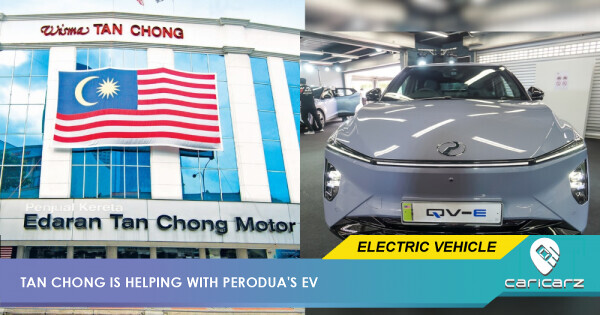
Yes, Tan Chong Is Involved In Perodua's EV. Here's What It's Actually Doing
Tan Chong has signed a three-year agreement to support Perodua's EV production with ED coating, painting and assembly-line services.
15-09-2026

BYD Has A New Plan For Malaysian-Made Cars, And It's Not Tanjung Malim
BYD has dropped its Tanjung Malim plant plan but says Malaysian CKD remains on track, with talks with an unnamed local partner at an advanced stage.
11-09-2026

Malaysia's EVs Are Growing Fast. The Chargers? Not So Much
Malaysia's EV registrations are surging, with 122,286 registered by July 2026. But can the country's 6,416 public EV chargers keep up?
10-09-2026

Could The Proton e.MAS 7 PHEV Get 230 KM EV Range And AWD Next? Its China Twin Says Maybe
The Proton e.MAS 7 PHEV's Geely twin is getting a larger 40.06 kWh battery, around 230 KM WLTP EV range and AWD. Could Malaysia get them too?
10-09-2026
Show More
trending_flat