2025 EV Bull Run Meets 2026 Policy Vacuum
-full_normal.jpg)
Two days into 2026, and one thing is immediately evident: CBU EV prices across brands in Malaysia have not moved. Online sites still display 2025 pricing, order books remain open, and consumers are not yet feeling the sting of the excise duty exemption ending on paper.
But this is not stability. It is inertia.
-full_normal.jpg)
 EV prices still remain same moving in 2026
EV prices still remain same moving in 2026
The reason is straightforward and widely understood within the industry. Most, if not all, EV brands rushed to import and declare substantial volumes of CBU inventory before the Dec 28, 2025 cut-off, parking vehicles in customs warehouses and bonded zones to qualify under the old tax regime.
What we are seeing now is not policy continuity, but the last afterglow of a loophole-driven inventory strategy. This temporary calm masks a more fundamental problem – the absence of a soft landing mechanism promised.
-full_normal.jpg)
Ex-MITI minister Tengku Datuk Seri Zafrul Abdul Aziz had previously confirmed in Oct 2025 that discussions with the Ministry of Finance are ongoing, but also that no concrete proposals have been tabled. That admission alone speaks volumes.
What the government however needs to understand is that the auto industry does not function on instant moves and overnight decisions. Product planning, production allocation, shipping schedules, homologation, dealer inventory and financing structures all operate on timelines measured in quarters, not weeks.
-full_normal.jpg)
By failing to offer clarity well before the end of 2025, policymakers have effectively forced brands into a defensive posture. Today, distributors are not planning fresh CBU replenishment. They are simply clearing what is already in hand. Once those stocks run dry, there is no visibility on what replaces them, at what price, or under what duty structure.
The immediate consequence is a quiet freeze. New EV model introductions are likely to slow down, not because brands lack products, but because committing to CBU imports without clarity on duties is commercially reckless. The safer pivot, at least in the short term, will be towards hybrids and PHEVs, where tax exposure is better understood and demand risk is lower.
-full_normal.jpg) 2026 at the surface looks like the year hybrids and PHEV take the forefront
2026 at the surface looks like the year hybrids and PHEV take the forefront
Yes, many brands have promised CKD EVs in 2026. But realism matters. Setting up assembly lines, validating suppliers, training labour and aligning quality systems takes time. Outside of Proton’s e.MAS 7, Perodua’s QV-E and Chery’s locally assembled E5, most CKD EVs will only materialise in late Q2 or early Q3 2026 at best. Even Proton’s e.MAS 5 remains a CBU import from China today.
Between now and then, the market sits in limbo.
-full_normal.jpg)
-full_normal.jpg)
This is where the cost of uncertainty becomes most apparent. 2025 was shaping up to be a genuine EV bull run, driven by price accessibility, broader model choice and growing consumer confidence.
However, by withholding a clear transition framework, MITI has effectively pressed pause on that momentum.
-full_normal.jpg)
The irony is that this pause comes precisely when Malaysia’s EV adoption curve needed continuity, not disruption. Charger rollout is already lagging, CPOs are scaling back amid low utilisation, and consumer sentiment remains price-sensitive. A sudden policy vacuum only amplifies hesitation across the ecosystem.
-full_normal.jpg)
Which brings us to the uncomfortable question. How does Malaysia realistically hit its electrification targets – 20% by 2030, 50% by 2040 and 80% by 2050 – if the bridge between incentives and localisation is left undefined?
Accelerating local assembly is a valid industrial objective. But without a measured transition, the risk is that affordability collapses before localisation matures. A soft landing was never about extending incentives indefinitely; it was about ensuring the runway was long enough for the aircraft to actually take off.
As of today, that runway looks worryingly short, don’t you think?
Written By
Kumeran Sagathevan
More then half his life spend being obsessed with all thing go-fast, performance and automotive only to find out he's actually Captain Slow behind the wheels...oh well!
JPJ Running Numbers
KUALA LUMPUR
VRT3770
SELANGOR
BSU3240
JOHOR
JF4631J
PULAU PINANG
PSG2798
PERAK
APM1159
PAHANG
CFH9721
KEDAH
KGJ4063
NEGERI SEMBILAN
NEM2338
KOTA KINABALU
SJU4821
KUCHING
QAB7352P
Last updated 08 Oct, 2026
Fuel Price
Petrol
RON 95
RM 3.97
+1.38
RON 97
RM 4.90
+1.75
RON 100
RM 7.20
+2.20
VPR
RM 8.23
+2.00
Diesel
EURO 5 B10
RM 5.12
+2.08
EURO 5 B7
RM 5.32
+2.08
Last updated 30 Apr, 2026
Related News
CIMB: EV Demand Will Be Resilient Despite End of Tax Holiday
CIMB says EV demand in Malaysia remains resilient thanks to front-loaded inventories and delayed OMV.
09-01-2026
Higher CBU EV Taxes, Higher Prices: Auto TIV to Fall 2% in 2026
CIMB Securities predicts auto TIV will fall 2% in 2026, driven by higher CBU EV taxes and higher vehicle prices.
30-12-2025
EV Tax Holiday Ends: CBU EVs to Lose Duty-Free Status from 2026
CBU EVs will no longer be tax-free after 2025, pushing automakers to accelerate local production plans.
10-10-2025
EV Tax Holiday Ends: CBU EVs to Lose Duty-Free Status from 2026
CBU EVs will no longer be tax-free after 2025, pushing automakers to accelerate local production plans.
10-10-2025
ASEAN Unity Drive 2025 Flagged Off In Malaysia
ASEAN Unity Drive 2025 embarks on a 9,000 KM journey, championing sustainable mobility and regional collaboration.
21-03-2025
Malaysian Vendor Gain Access To Chery’s Global Supply Chain
Chery Malaysia & MIDA connects local vendors to Chery’s global supply chain technology hub.
10-12-2024
Zafrul: MITI Will Assist Perodua To Produce EV Under RM100K
MITI will assist Perodua in realising production of EV under RM100K by end 2025.
22-10-2024
Perodua, Sime Darby Motors Discuss EV Development And EV Battery Recycling With MITI
Tengku Zafrul reveals via X (Twitter) of discussions Between MITI with Perodua and Sime Darby Motors regarding EV development and EV battery recycling.
26-03-2024
Latest News
EV Charging Incentives: Malaysia vs Other Countries
Malaysia offers EV charging tax incentives, but how does it compare globally? Explore EV charger subsidies, grants and tax breaks in six other markets.
08-10-2026
Proton Sold 40,000 e.MAS Cars. But That's Not Even The Most Interesting Number
Proton e.MAS has delivered 40,000 vehicles, but the e.MAS 5's place among Malaysia's best-selling cars tells an even bigger EV story.
30-09-2026
Kuching Gets Zeekr's First East Malaysia Store, With More Coming Next Year
Zeekr opens its first East Malaysia retail location at The Spring Kuching, with permanent sales and service centres targeted for Q1 2027.
29-09-2026
Buying A Hybrid Or EV? MAA Proposes Up To RM10,000 Tax Rebate
MAA proposes a RM7,000-RM10,000 income tax rebate for hybrid and EV buyers under Budget 2027, plus incentives for home charging and old-car scrapping.
28-09-2026
Driving Up North In An EV? There's A New 240 kW Charger At Rawang R&R
TNB Electron's new 240 kW DC EV charger at R&R Rawang Northbound is now live, with free charging available until 29 Sept 2026.
28-09-2026
Could An EV Really Work As A Malaysian Police Car? PDRM Is Finding Out
PDRM is testing the Proton e.MAS 5, e.MAS 7 EV and e.MAS 7 PHEV to see whether electrified vehicles could work for Malaysian police duties.
18-09-2026
Malaysia's Electricity Protection Is Now 800 kWh - How Much Power Does An EV Use Per 100 KM?
Malaysia's electricity protection threshold is now 800 kWh. Here's how much electricity popular EVs use per 100 km and what the extra 200 kWh means.
18-09-2026
17 New Mercedes Models Are Coming To Malaysia In 2027 - Here's What We Know
Mercedes-Benz Malaysia plans 17 new models for 2027, with most set for local assembly in Pekan. Here's what we know about its ICE and EV plans.
17-09-2026
Show More
trending_flat
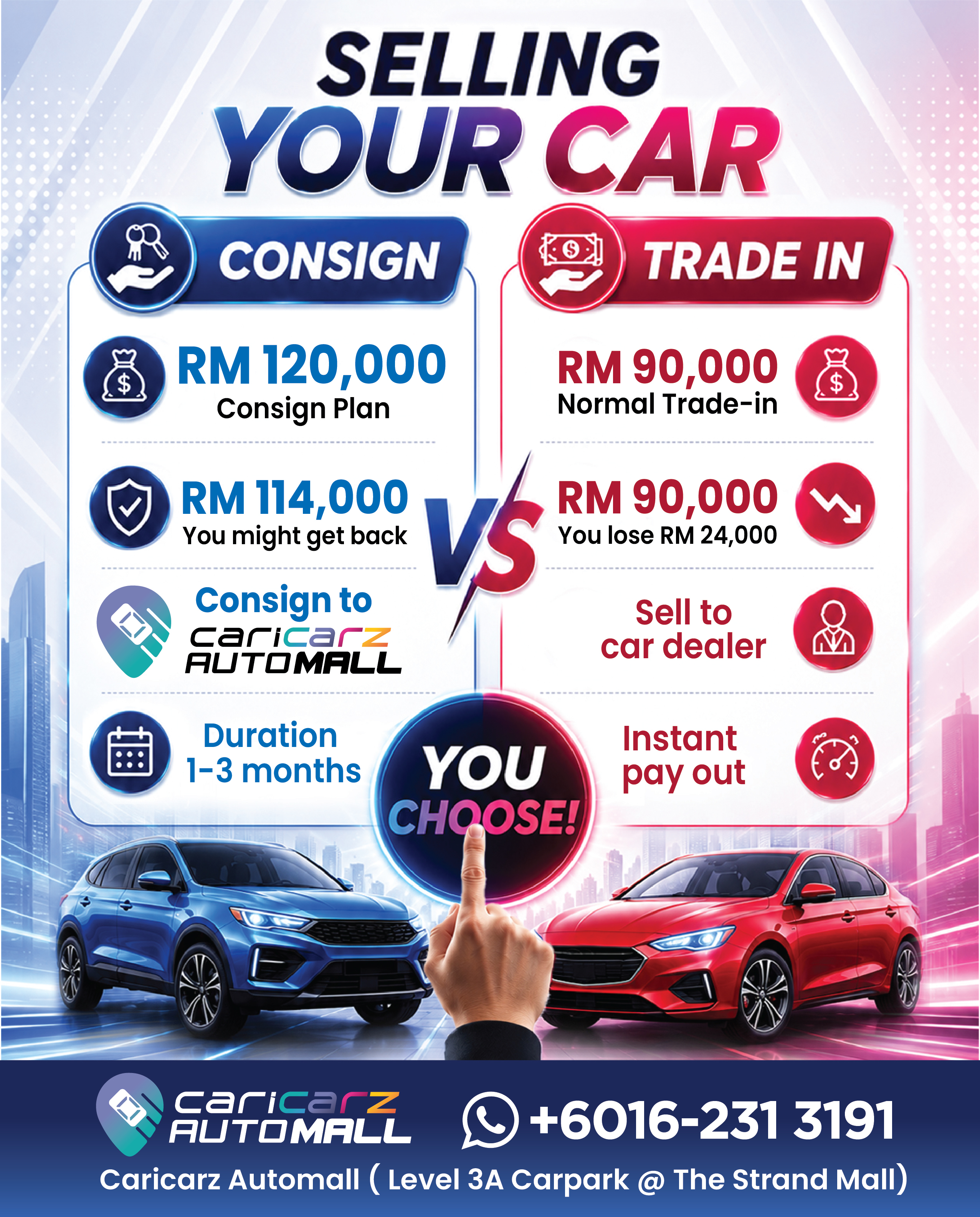
Malaysia First Used Car and EV Consignment Platform
This is the best place to sell your car at true market value. Instead of accepting low dealer trade-ins, we handle everything and connect your car directly to genuine buyers for the highest price.

Understanding CariCarzAutomall Consignment Plan

Approved 200-Check Points Inspection

7 Day Money Back Guarantee

One Year Extended Warranty

No Hidden Charge